Conversations Catalyst from The People Mentor provides difficult conversations coaching and private mentoring for managers across the UK. Designed for employers investing in one manager, the three-month programme includes six virtual sessions, a Wiley DiSC profile and practical support using Nicola Richardson’s COMPASS Conversations framework. Managers work on real performance, behaviour and working-relationship issues, developing the skills and judgement to handle conversations with greater clarity, confidence and calm authority. The programme costs £1,500.
Conversations Catalyst for Employers
Private mentoring for managers who need to handle difficult workplace conversations
Your manager knows what they need to say. Help them have the conversation.
You have a capable manager who understands their responsibilities. But when it comes to addressing performance, behaviour or difficult working relationships, something keeps getting in the way.
The conversation gets delayed. The problem continues. And before long, it is back on your desk or with HR.
I help managers work through the real situations they are facing, prepare for the conversations they have been putting off, and develop the judgement to handle more of these issues themselves.
Three months of private mentoring for one manager. Six sessions. £1,500.
We'll talk through the situation, what you've already tried and whether private mentoring is the right support. There is no obligation to proceed.
You have already had this conversation with your manager. Why hasn't anything changed?
Three weeks later, the conversation still hasn't happened.
You have explained what needs to happen.
Your manager understands. They agree with you. You both leave the meeting clear about the next step.
Perhaps they are worried about upsetting somebody. Perhaps they are unsure how firm they can be, or they tried to address something before, and it went badly.
Sometimes the problem is more complicated. The manager may not have made their expectations clear in the first place. They know something needs to change, but they aren't entirely sure what the right conversation should be.
Meanwhile, you are having the same discussions again.
You don't want to give up on this manager. You can see their strengths and what they could become with the right support.
But you also need them to take more responsibility for the people they manage.
That is where Conversations Catalyst can help.
What the delay is costing you
ACAS research estimates that workplace conflict costs employers an average of £2,939 a year for each employee involved in conflict.
One person. One year.
It's an average, so the cost in your organisation may be different. But it gives you a sense of the scale.
In your organisation, that cost rarely lands on one budget line. That's what makes it easy to overlook.
It shows up in your time instead. The second, third and fourth conversation about a problem that should have been addressed earlier. The quiet word that becomes an informal investigation.
Then there's the capable employee who starts looking elsewhere because nothing seems to be happening about the behaviour or performance issues affecting their team.
It can also create risk. A performance concern that hasn't been properly addressed or documented may become harder to manage fairly. An unresolved behaviour issue can develop into a grievance.
And the longer things continue, the harder it can become to establish what happened, what was agreed, and what should happen next.
ACAS estimates that managing formal disciplinary and grievance procedures costs UK employers £2.36 billion a year.
In July 2026, Acas highlighted those costs when announcing a consultation on updating its disciplinary and grievance Code of Practice, emphasising the value of resolving concerns early, fairly and informally where appropriate.
The cost in perspective
Annual conflict cost per person
£2,939
Three months of private mentoring
£1,500
£2,939 compared with £1,500
The estimated annual cost of workplace conflict involving one employee is almost twice the investment in three months of private mentoring for a manager.
That doesn't mean mentoring will automatically prevent those costs. Every workplace situation is different.
But it does put the investment into perspective.
For £1,500, you can give a capable manager individual support to address real situations earlier, develop better judgement and become less reliant on you or HR to guide every difficult conversation.
The aim isn't to keep everything away from HR. It's to make sure the right issues reach the right people at the right time.
Why another course isn't the answer
Your manager may already have completed management training. They probably understand the importance of setting expectations, giving feedback and dealing with problems early.
But understanding the principle and applying it are two different things.
The real test happens at four o'clock on a Thursday, when the person sitting opposite them becomes upset, challenges what they are saying or raises something the manager hadn't considered.
That is when confidence, judgement and the ability to listen really matter.
A course can teach useful principles. But it cannot always help a manager work through the particular situation sitting on their desk today.
When I work privately with a manager, we start by understanding what is stopping them.
It might be that:
- 01 They are worried about being unfair or damaging a working relationship.
- 02 They aren't clear about the decisions they can make themselves.
- 03 A previous conversation went badly, and they are reluctant to try again.
- 04 The expectations were never properly agreed, which means the situation is not as straightforward as it first appeared.
These are different problems, and they need different responses.
I don't simply teach managers what they ought to say. I help them work out what is really happening, what needs addressing and how to take the next sensible step.
How Conversations Catalyst works
Conversations Catalyst is three months of private mentoring, built around your manager's actual workplace challenges.
The aim is to help them become more thoughtful, clear and consistent in how they manage people, rather than dependent on somebody else to tell them what to do.
We begin with understanding the manager
Our first session lasts approximately 90 minutes.
We use their Wiley DiSC profile to explore communication preferences, behavioural tendencies and how they may respond under pressure.
It gives us a starting point for discussing where their style helps, where it may create difficulties, and how others might experience their approach.
We then connect those insights to the real people-management situations they are facing.
This isn't about putting somebody into a personality box. It is about developing greater awareness and making more deliberate choices.
What's different in three months
The measure isn't how your manager feels about difficult conversations. It's what arrives on your desk.
-
Problems raised earlier
They raise things while they're still small, so you hear about a problem when it's still a conversation, not when it's a process.
-
Decisions they can explain
They can tell you what they've decided and why, instead of asking you what they should do.
-
Steadier when someone pushes back
When someone pushes back, they hold the line without caving or hardening, something most managers never learn.
-
Clear about when to involve you
They know where their authority ends. That cuts both ways: fewer decisions escalated to you that didn't need to be, and fewer decisions made alone that should have come to you first.
And you'll notice soon that you stop having the same conversation twice.
The follow-up happens without you chasing it.
I won't tell you every situation resolves within three months, because some are personnel matters with their own timelines, and some employees won't change no matter what the manager does.
On our first call, we'll agree on what useful progress looks like in your organisation, and you'll know before you commit whether I can help.
Then we work on the conversations that matter
From the second session onwards, we work with live workplace situations using my COMPASS Conversations framework.
1. Understand what's really happening
We separate what the manager knows from what they have assumed.
We look at what happened, what was communicated, what expectations were set, and what the other person might reasonably understand.
Sometimes the issue becomes much clearer once we ask better questions.
2. Work out what needs to be said
We identify the conversation that needs to happen.
That includes the concern, the standard or expectation, the manager's responsibility and what needs to change.
We consider how to be direct without being unnecessarily harsh, and how to listen without losing sight of the issue.
3. Prepare and practise
The manager works out how to explain the issue in their own words.
We consider how the other person might respond, including disagreement, emotion, defensiveness or information that changes the situation.
I don't want managers relying on a script that stops being useful the moment a conversation takes an unexpected turn.
I want them to understand what they are trying to achieve and be able to respond thoughtfully.
4. Have the conversation and review what happened
The manager takes what we have discussed into their workplace.
When we meet again, we review what happened, what they noticed, what worked and what still needs attention.
We consider what should happen next and whether the situation needs further management action or HR involvement.
Over the three months, we repeat that process with the situations that matter most.
The manager gains practice in making decisions, having conversations and following through.
What does that look like in practice?
Imagine a manager who is frustrated because a team member keeps missing deadlines.
They have reminded the person several times, but nothing has changed. They believe they need to be firmer and are worried about how the employee will react.
Before preparing a difficult performance conversation, I would want to understand what has happened.
- Was the deadline clearly agreed, or was it implied?
- Did the employee understand what was expected?
- Were there obstacles the manager hadn't recognised?
- Was support promised but not provided?
- Has the manager addressed the issue directly, or have they relied on hints and reminders?
Those questions matter because the right conversation depends on the real problem.
It may be about performance and accountability. It may be about unclear expectations, workload or a breakdown in communication. Sometimes more than one issue is involved.
The manager still needs to deal with the situation. But now they can approach it with greater clarity and fairness.
That is the difference between reacting to a problem and managing it properly.
What should be different after three months?
The measure of useful mentoring isn't simply whether a manager says they feel more confident.
It is whether they are better able to put what they have learned into practice.
At the beginning of the programme, we agree what useful progress would look like for the manager and your organisation.
Depending on the situation, that might mean seeing the manager:
Raise issues earlier
They become better at recognising when something needs addressing and are less likely to hope it sorts itself out.
Communicate expectations more clearly
People understand what is expected, what has been agreed and what needs to happen next.
Make decisions they can explain
Instead of bringing every decision to you, they develop the confidence to consider the facts, use their judgement and explain their reasoning.
Handle disagreement more steadily
They listen, remain fair and keep the conversation focused without avoiding the difficult part or becoming unnecessarily confrontational.
Follow through
They become more consistent about checking what has changed and deciding what needs to happen next.
Know when to involve HR or senior leadership
They recognise which issues they can handle within their authority and which need additional support or a formal process.
Not every workplace situation will be resolved in three months, and I wouldn't promise that.
I want your manager to leave better equipped to manage the situations they face now and those that will arise in the future.
What people say about working with me
Every manager brings a different situation to our work. What matters is helping them understand what's happening, strengthen their judgement and put what they learn into practice.
Nicola is a mentor who truly invests in people. She challenges, supports, and empowers with a rare blend of wisdom, authenticity and empathy.
Nicola’s training gave our staff member the confidence and self-belief we always knew she had. Her support ensured our dispensary has a bright future with strong leadership and fresh ideas.
Nicola’s Zoom training for Team Leaders was insightful, practical, and invaluable.
These testimonials reflect experiences of Nicola's wider mentoring and management-development work.
Who this mentoring is right for
Conversations Catalyst is designed for employers who have a capable manager they want to develop.
It may be a good fit if:
- The manager is technically capable but less confident with the people side of their role.
- Performance, behaviour or working-relationship issues keep being delayed or passed upwards.
- Previous training has not translated into enough practical change.
- You want to support one manager with situations that need individual attention.
- The manager is willing to reflect on their own approach and put what they learn into practice.
I work with employers across the UK, including organisations in professional services, technology, housing, local government, charities and other service-led sectors.
The programme is particularly relevant where HR or senior leaders keep being drawn into everyday management issues that managers could reasonably handle with better support and judgement.
When it isn't the right answer
I will also tell you when I don't believe private mentoring is appropriate.
If your manager doesn't know why they have been referred, we need to address that before starting. They don't have to arrive enthusiastic, but they do need to understand the purpose and be willing to take part.
If you have already decided the manager is unsuitable for the role and simply need a record of development activity, mentoring should not be used to disguise that decision.
And if several managers are struggling with the same problems, a wider development programme may be a more appropriate investment.
Some situations also need immediate HR, safeguarding, legal or formal organisational action. Mentoring isn't a substitute for those responsibilities.
What your £1,500 includes
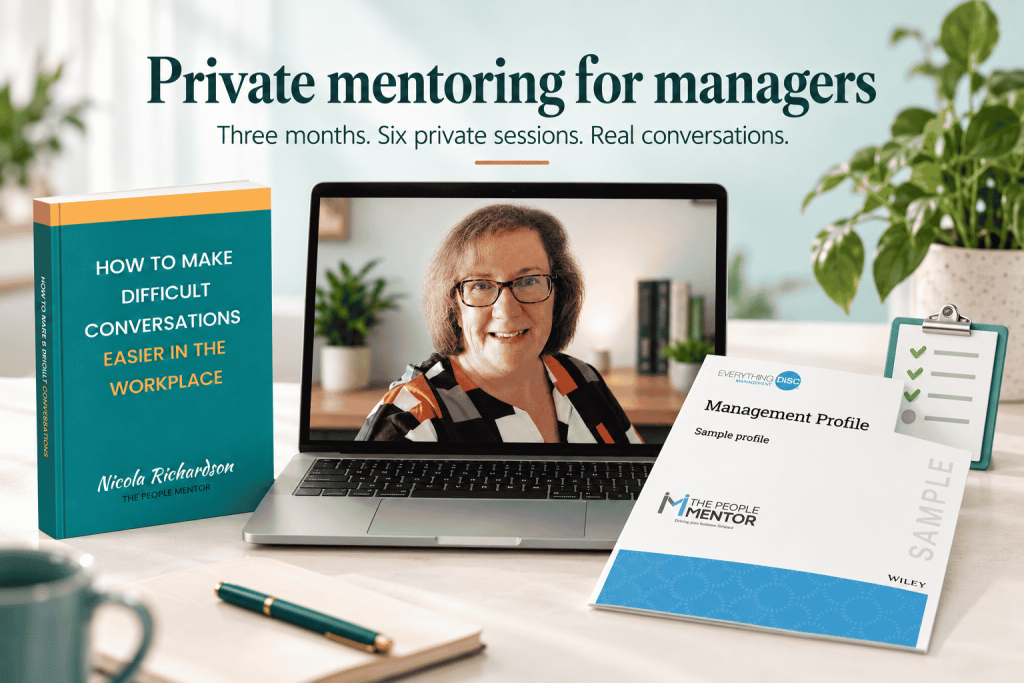
Conversations Catalyst provides private support for one manager over three months.
Six individual mentoring sessions
Two sessions per month. The first lasts approximately 90 minutes, followed by five sessions of approximately 60 minutes each.
Wiley DiSC assessment and feedback
A structured starting point for understanding communication preferences, behavioural tendencies and areas for development.
The COMPASS Conversations framework
A practical structure the manager can continue using when preparing and handling workplace conversations.
Additional preparation and review support
Up to three pairs of additional 30-minute calls, where a particular conversation would benefit from more focused preparation and follow-up.
Support between scheduled sessions
Access to me by email or WhatsApp for appropriate questions arising from the mentoring. I normally aim to respond within 24 hours.
Practical learning resources
A printed Difficult Conversations Journal and relevant short online learning resources to support the work we are doing together.
The programme is delivered virtually, allowing managers to receive support without regular travel or extended time away from work.
Investment: £1,500 for one manager
You can pay in full or make three payments of £500, due before sessions one, three and five.
I am not VAT registered, so no VAT is added.
For employers seeking development for several managers, we can discuss a different arrangement.
How confidentiality works when your organisation is paying
This matters, and I prefer to be clear about it from the beginning.
Before mentoring starts, the manager, employer and I agree on the development aims and what progress information will be shared.
You need to know what you are investing in and whether the work is moving in the right direction.
The manager also needs space to reflect honestly on situations they find difficult, including where they may have made mistakes or contributed to a problem.
You can expect agreed development goals and appropriate high-level progress information.
I don't report everything the manager says during their private sessions.
We also agree the limits of confidentiality, including circumstances where information may need to be shared because of safeguarding, legal or other relevant obligations.
Mentoring works best when everyone understands those boundaries from the start.
Why work with me?
I'm Nicola Richardson, founder of The People Mentor.
I've spent around 40 years working in management, leadership and operational environments, including my family's business and the Civil Service.
I've managed teams, handled difficult situations, and felt the pressure of making decisions that affect other people.
I know there is often more going on underneath a workplace problem than the first explanation suggests.
A manager might appear to be avoiding responsibility when they are actually uncertain about what is fair. An employee might appear uncooperative when expectations have never been clear. Equally, sometimes the standard is clear, and the manager needs support to address behaviour that cannot continue.
The skill is knowing the difference.
I'm a Chartered Fellow of the Chartered Management Institute and a Chartered Manager. I also wrote How to Make Difficult Conversations Easier in the Workplace.

My approach is calm, practical and supportive, but I won't simply agree with your manager to make them feel better.
I will ask questions, challenge assumptions and help them look at their own part in what is happening.
I believe you can treat people with kindness while still expecting accountability.
And I believe good managers should have the support to develop that balance.
A practical investment in one of your managers
£1,500
For three months of private mentoring.
What you are investing in is more than six conversations with an experienced mentor.
You are giving a manager the opportunity to work through real challenges, practise a more effective approach, review what happens and develop skills they can continue using long after our work finishes.
That has value for the manager, the people they lead and the senior colleagues who currently spend time helping them navigate difficult situations.
We will agree what meaningful progress should look like before the programme begins.
You will receive the proposed scope, dates and terms in writing before making a commitment.
Let's talk about the manager you want to develop
On our introductory call, I'll want to understand three things:
- 01 What situations keep coming back to you or HR?
- 02 What support or training has the manager already received?
- 03 What would you like them to handle more independently over the next three months?
I'll give you my assessment of whether Conversations Catalyst is suitable.
If I think another type of support would be more useful, I'll say so.
And if we agree it's a good fit, I'll explain the next steps and provide a written proposal.
No obligation to proceed. You don't need to prepare anything in advance, and please avoid including names or sensitive employee details in your initial enquiry.
Frequently asked questions
How is mentoring different from management training?
Management training introduces knowledge, techniques and approaches that can be applied across different situations. Private mentoring allows us to work on the actual situations your manager is dealing with. We examine the issue, prepare for the conversation, and review what happens when they put their learning into practice.
Does the manager need to be struggling with their performance?
No. The programme is for capable managers who need additional support with particular aspects of managing people. It is not intended to replace an appropriate formal performance or capability process.
What information will the employer receive?
We agree the development aims and reporting boundaries before mentoring starts. The employer can receive agreed, high-level progress information, while the manager's private conversations remain confidential within the boundaries explained at the outset.
What if the situation needs HR involvement?
Part of developing management judgement is recognising when to escalate an issue. Mentoring does not replace HR policies, formal procedures, safeguarding responsibilities or legal advice.
What happens if the manager needs help between sessions?
The programme includes appropriate between-session support by email or WhatsApp, alongside the scheduled sessions and additional preparation and review calls. The scope and boundaries of that support are agreed before work begins.
Is the programme delivered online?
Yes. Sessions are delivered virtually, making the programme available to employers and managers across the UK.
How much does Conversations Catalyst cost?
The programme costs £1,500 for one manager over three months. You can pay in full or in three payments of £500. No VAT is added.
Can I arrange mentoring for more than one manager?
Yes, we can discuss your requirements. If several managers need similar support, I may recommend a wider management-development approach instead of separate individual programmes.
What happens on the introductory call?
We'll explore the situation, what has already been tried and what you want to change. I'll explain whether mentoring appears appropriate and answer your questions about delivery, confidentiality and the investment. If we decide to proceed, I'll provide the details in writing.