This article covers everything inside Making Difficult Conversations Easier — the difficult conversations training programme for UK managers who are ready to handle the conversations they have been putting off., including who it is for, what the training involves, how the surgery sessions work, what frameworks you will learn, and what changes after you complete it. If you have been considering the programme and want to know exactly what you are signing up for before you commit, this is the place to start.
Written by Nicola Richardson, Founder of The People Mentor. The People Mentor helps small employers, managers and leaders handle difficult conversations, strengthen accountability and lead with calm, practical confidence.
Key takeaways from The People Mentor
- Managers who avoid difficult conversations are not weak. They are undertrained and underequipped.
- Making Difficult Conversations Easier gives you a structure you can follow in any people conversation, not just the obvious ones.
- The surgery sessions are where real skill-building happens. You bring a real situation and work through it live.
- The COMPASS framework, the AID model, and DiSC profiling work together to cover preparation, delivery, and understanding the person in front of you.
- For £295, you get 12 months of access to training, live sessions, templates, and community support.
- The programme is for managers who are ready to do things differently, not for those still hoping the issue will resolve itself.
Why This Difficult Conversations Training Programme Exists
In over 40 years of working in and around organisations, I have watched the same pattern play out repeatedly.
A capable, committed manager is given responsibility for a team. They are good at the job itself. They know the business. But the moment a conversation becomes difficult, a performance issue, a behaviour problem, a piece of feedback that might land badly, they go quiet. They delay. They soften the message until it has no effect. Or they avoid the whole thing and hope it sorts itself out.
It rarely does.
What I have noticed, across every sector and every size of organisation I have worked with, is that the avoidance is almost never about attitude. Most managers care deeply about their people. They want to get it right. What they are missing is a clear structure for doing it. They were promoted because they were good at the technical work, not because anyone taught them how to lead people through hard moments.
I wrote about this in more detail in why avoiding difficult conversations is so damaging to your team, but the short version is this: the longer a conversation is delayed, the more expensive it becomes. Not just emotionally. Financially.
Making Difficult Conversations Easier exists to change that. Not with theory. Not with a two-day course that gets forgotten by Monday. With a structured programme that builds real skill over time, with live support when real situations arise.
Who This Difficult Conversations Training Is For
This difficult conversations training UK works best for managers, team leaders, and founders in UK businesses with between 5 and 200 employees who know they are avoiding conversations they should be having. Difficult conversations training includes everything you need to prepare for and follow up on difficult conversations
You might be putting off a performance conversation that has been brewing for months. You might have given vague feedback that did not land. You might be dreading a particular team member, or lying awake at night rehearsing a conversation you have not yet had. You are technically capable, but the people side of your role feels harder than it should.
That is exactly who this is built for.
It is also worth reading 10 surprising things you probably don’t know about difficult conversations before you join. It gives you a sense of how I approach this work and whether it resonates with where you are.
The programme is not right for everyone. It will not suit the manager who wants a script to read out and then walk away. Or the business owner who believes the problem is entirely the other person. Or the leader who is still hoping the issue will resolve itself without them having to say anything.
The people who get the most out of it come in ready to practise. They bring real situations. They apply what they learn in the week between sessions. If that is you, read on.
What This Difficult Conversations Training Covers
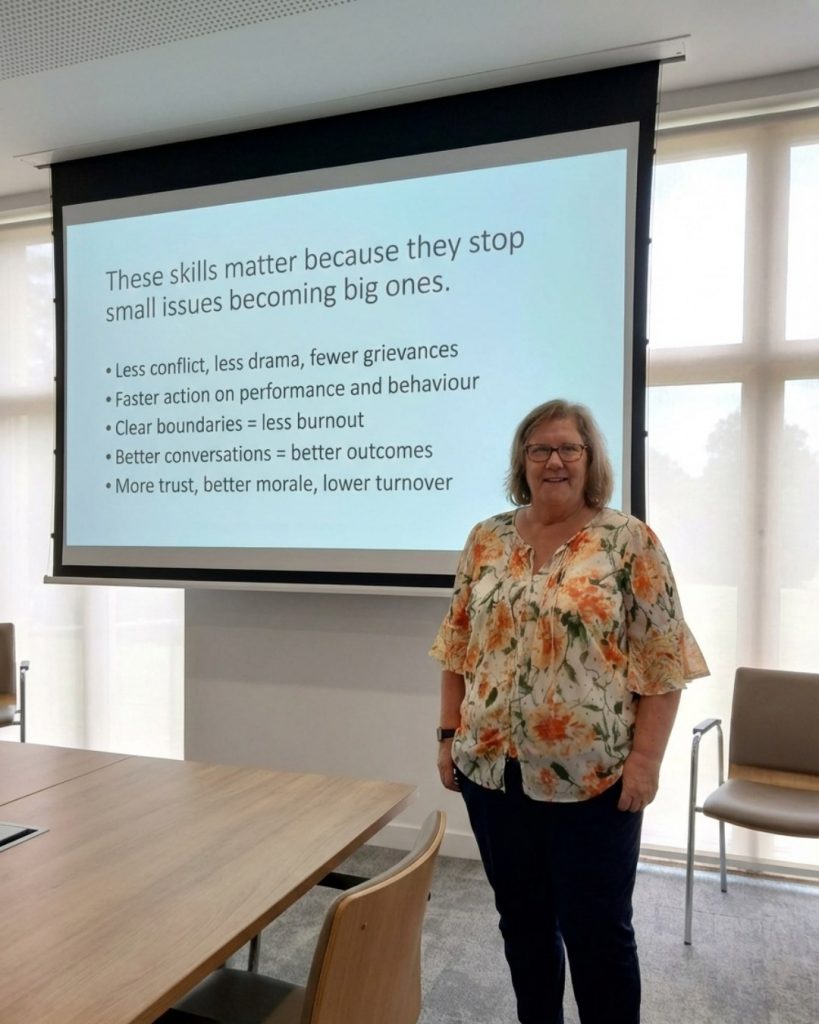
Making Difficult Conversations Easier is a structured difficult conversations training programme that combines on-demand video training, live Zoom sessions, practical frameworks, and 12 months of community access. Here is exactly what is inside.
The online training modules
The video training in this difficult conversations training covers the full landscape of conversations at work, not just the most obvious situations. The modules work through:
- Introduction to Difficult Conversations. Why they feel hard, what gets in the way, and what you need to consider before you start.
- Understanding Yourself and Your Team. Self-awareness in difficult conversations and how to read the person in front of you.
- Emotional Intelligence. What it is, the four key aspects, self-management, and how to deepen it in practice.
- Managing Emotions. Understanding and managing emotions in the room, including stress, crying at work, and hot-button reactions.
- Preparing for Conversations. Planning the conversation, getting yourself ready, and applying the AID model.
- Giving and Receiving Feedback. The insight behind effective feedback, how to give it well, and how to handle negative feedback.
- Handling Conflict. Avoiding or seeking conflict, dealing with different types, resolving conflict between team members, and building rapport.
- Handling Underperformance. A dedicated module on one of the most common and most avoided conversations managers face.
- Practical Application. Scenario-based learning including filmed examples and review sessions.
- Specialised Conversations. Refloating difficult team members and welcome back interviews.
- Review the Conversation. How to reflect and improve after a difficult conversation has happened.
You have 12 months of access to all of this, so you can revisit modules when a new situation arises rather than trying to absorb everything at once.
The live Teams sessions
This is the live support element that sets this difficult conversations training apart from self-study courses.. These are not recordings. They are not pre-recorded webinars with a Q and A bolted on. They are live, interactive, and built around what you are actually dealing with.
- Monthly leadership surgery. Bring a real situation and work through it live with the group.
- Monthly live training session. Go deeper on a key topic, build confidence and ask questions in real time.
Both sessions are led by me personally. You get real-time feedback, honest responses, and the kind of support that does not happen in a self-study course.
Surgery sessions: how they actually work
The surgery session is the part of the programme people tell me they did not expect to value as much as they do. It is also where the difficult conversations training moves from theory into something you can actually use the following week.
You turn up with a real situation. Something you are facing right now. A conversation you are preparing for, one that went wrong, or a dynamic in your team that you cannot quite get a handle on. We work through it together using the COMPASS framework. You see how the model applies to your specific context, not a case study. You hear how other managers think through similar problems. You leave with something concrete to do next.
It is not therapy. It is not a debrief. It is applied problem-solving in a safe, confidential space with people who understand what managing a team actually feels like.
The surgery session is what turns the difficult conversations training into something that sticks.
COMPASS, AND AID
Three frameworks sit at the centre of this programme. Each one does a different job.
COMPASS is my practical conversation model for preparing, opening and following through on difficult workplace conversations. It stands for Create Safety, Observe, Motive Check, Present Impact, Ask for Perspective, Suggest Desired Outcome and Secure Action Plan. The model gives managers a clear route through the conversation, so they are not left improvising when emotions are high, standards need protecting or something important needs to be said.
AID is the feedback model at the heart of the Preparing for Conversations module. Action, Impact, Desired Outcome. It keeps the conversation grounded in what actually happened, what it cost, and what needs to change. You can read more about preparing effectively in 4 easy steps to preparing for difficult conversations.
Together, these two tools cover preparation, delivery, and understanding. They are what make this difficult conversations training practical rather than academic. They are the three things that determine whether a difficult conversation goes well.
What you get alongside the training
This difficult conversations training includes everything you need to prepare for and follow up on difficult conversations, not just the training itself.
- Plug-and-play templates and conversation prep sheets, so you always have a clear starting point.
- Scripts and printable frameworks to guide every stage of a conversation, including follow-up.
- A manager’s journal for reflection and real-world application.
- The 10 Commandments of Difficult Conversations video, a bonus resource that gets used repeatedly by programme graduates.
- 12 months of access to the private Heartbeat community, a leader-led space where you can ask questions, share challenges, and get honest, supportive feedback between sessions.
The community is not a passive resource. It is actively supported by me and by a peer group of managers and founders who understand what you are carrying. Support between the live calls, not just during them.
What Changes After Completing This Difficult Conversations Training
At The People Mentor, the measure of this programme is not how much content someone has consumed. It is whether they have the conversation they were avoiding, and whether it went better than they expected.
Here is what I observe in managers who complete this difficult conversations training:
| What you notice before | What it often means | What shifts after the programme |
| Conversations get delayed for weeks or months | No clear structure to follow under pressure | You prepare using COMPASS and act early |
| Feedback lands vaguely or not at all | The message gets softened until it disappears | AID gives you a specific, observable anchor |
| You feel sick before a difficult conversation | Emotional charge is running the preparation | You centre yourself first and lead calmly |
| The same issue keeps coming back | The conversation happened but nothing was secured | You end every conversation with a clear agreed action |
| You adapt your style to everyone the same way | DiSC profiling not yet applied | You read the person and adjust before you start |
| You step in to sort things yourself | Managers lack the confidence to act without you | Managers bring situations to surgery and handle them |
The change that most managers describe is not dramatic. It is a shift in how they feel before the conversation starts. The dread does not disappear entirely. But it becomes manageable. And the conversation, when it happens, is almost always calmer than they expected.
This connects to something I cover in depth in the different types of difficult conversations and how to make them easier. The conversation most managers are dreading is usually different to the one they end up having once they are properly prepared.
The investment
Making Difficult Conversations Easier is £295.
For that you get 12 months of access to the full video training library, two live Teams sessions every month, the Heartbeat community, all templates and frameworks, and the bonus materials.
If you booked monthly leadership coaching at this level privately, you would spend over £1,000 for the live support alone. This programme gives you that plus the full training system and ongoing community.
If you have been looking for practical difficult conversations training in the UK that goes beyond theory, this is built for exactly that.. It is what the current situation is costing you. A performance issue left unaddressed for six months. A team member whose behaviour is affecting everyone else. A conversation that has circled in your head for three weeks. The cost of avoidance is always higher than the cost of the programme. For independent guidance on managing performance and workplace conversations, ACAS provides free resources for UK employers.
If you want more context on what management training actually returns to a business, this piece on the ROI of management training is worth reading before you decide.
How to join
This difficult conversations training is available now for £295 with instant access from day one. If you have read this far and you recognise yourself in what I have described, the next step is straightforward. This difficult conversations training is built for managers who are ready to do something different.
This difficult conversations training is available now. You can join the programme at thepeoplementor.co.uk/making-difficult-conversations-easier-programme for £295. You get instant access to the full training library, the live sessions, the community, and all the templates and frameworks from day one.
If you are not sure whether it is the right fit, you are welcome to book a free, no-pressure call with me first. I would rather have that conversation than have you join and feel it was not what you needed.
The managers who get the most out of this programme are the ones who arrive ready to bring a real situation and do something different the following week.
If that is you, I would love to have you in the room.
At The People Mentor, I believe that the confidence to have a difficult conversation is a skill and that difficult conversations training, done properly, is how that skill gets built.. Like every skill, it builds with the right framework, real practice, and support when it matters. Making Difficult Conversations Easier is built around exactly that.