This is the complete guide to difficult conversations in the workplace -- how to prepare for them, how to start them, and what to do when they go wrong.
Written by Nicola Richardson, Founder of The People Mentor. The People Mentor helps small employers, managers and leaders handle difficult conversations, strengthen accountability and lead with calm, practical confidence.
This guide covers everything managers and leaders need to know about difficult conversations in the workplace – what they are, why we avoid them, how to prepare for them properly, and how to handle the moments when they go sideways. If you manage people, this is the most practical thing you can read today.
Key Takeaways from The People Mentor
- Difficult conversations do not get easier by being avoided – they get more expensive
- Most managers avoid these conversations because they lack a structure, not because they lack courage
- Preparation is what separates a productive conversation from a damaging one
- The goal is not to win the conversation – it is to change something that needs to change
- You do not need the other person to agree with you — you need them to understand what you observed and what needs to be different
- The managers who handle these conversations well are not more confident than you – they have simply done it enough times to have a method
What Makes a Workplace Conversation Difficult?
Not every uncomfortable conversation is difficult in the same way. Difficult conversations in the workplace are ones where the stakes feel high, emotions are running close to the surface, or the relationship itself feels at risk. It is the kind of conversation you rehearse in the shower at 7am and then put off until Thursday.
What makes it difficult is rarely the topic itself. Performance conversations are not inherently difficult. Neither are conversations about behaviour, attendance, or conflict between colleagues. What makes them difficult is the combination of emotional weight and uncertainty – you do not know how the other person will react, you do not want to damage something that matters, and you are not sure you have the right words.
The result? Most managers wait far too long. They hope the situation resolves itself. It rarely does. And the longer they wait, the harder the conversation becomes – because now there is a pattern to address, and the other person knows you have been watching it unfold without saying anything.
At The People Mentor, I have worked with many managers across small and medium-sized businesses over more than three decades. The single most consistent thing I see is this: the conversation that felt impossible to start was almost always possible once someone gave them the right structure.
The Most Common Difficult Conversations Managers Face
Difficult conversations in the workplace come in many forms, and most managers will face all of them at some point in their careers.. Here are the ones managers bring to me most often:
Performance and underperformance. Someone is not delivering what the role requires. Targets are being missed. Work quality is inconsistent. You have noticed it, your team has noticed it, and now you need to do something about it.
Attitude and behaviour. This is often harder than performance, because it feels more personal. Acting superior towards colleagues, dismissing other people’s ideas, taking credit for team output — these behaviours are real, but they are also harder to describe objectively. You can see the impact even when the behaviour is hard to pin down. If you are managing someone who acts superior to others in your team, there is a dedicated post on exactly that here.
Conflict between team members. Two people who cannot work together professionally. One colleague undermining another. A dynamic that is affecting the rest of the team even if the two people involved have not raised it directly with you. If someone in your team is feeling undermined at work, that situation rarely resolves without a manager stepping in.
Sensitive personal situations affecting work. Someone going through something difficult in their personal life — bereavement, health problems, relationship breakdown — and it is starting to affect their work. These conversations require more care, not fewer.
Conversations with your boss. Raising something difficult upwards — pushing back on a decision, flagging a concern, addressing something your line manager has done that has affected you or your team. These feel different because the power dynamic is reversed, but the principles are the same.
Redundancy, restructure, and role change. Conversations no manager looks forward to. High stakes, often legally sensitive, and emotionally significant for the person receiving the news.
| Type of difficult conversation | What's at stake | Key mistake managers make | |
|---|---|---|---|
| Performance or underperformance | The person's role, your team's output | Waiting too long, then overloading in one conversation | |
| Attitude or behaviour | Team morale, trust, psychological safety | Being vague — "you need to be more of a team player" | |
| Conflict between colleagues | Productivity, retention, team culture | Trying to mediate without addressing the root cause | |
| Sensitive personal situations | The relationship, legal duty of care | Avoiding the conversation to avoid seeming intrusive | |
| Conversations upward | Your credibility, the team's outcome | Framing it as a complaint rather than a professional concern | |
| Redundancy or role change | Dignity, legal compliance, trust | Underpreparing for the emotional response |
Why Most Managers Avoid Difficult Conversations in the Workplace (And What It's Costing Them)
Let’s be honest about this, because the reasons managers avoid these conversations are understandable.
They do not want to damage a relationship that is otherwise working. They do not know how to start without it becoming personal. They are worried the other person will become upset, or angry, or go off sick, or raise a grievance. They are hoping the situation will quietly improve on its own.
None of these are irrational concerns. But every one of them leads to the same outcome: the situation gets worse, and the conversation gets harder.
Here is what avoidance actually costs:
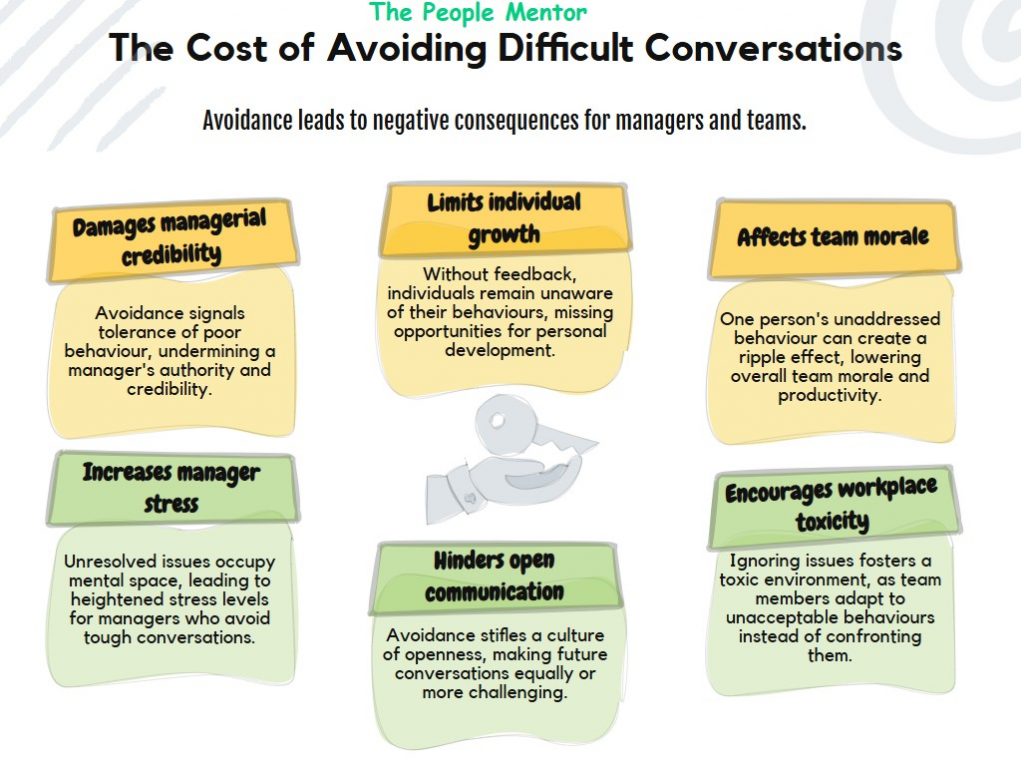
Your credibility as a manager. Your team is watching. They can see the behaviour you are tolerating. When you do not act, the message you send – even without meaning to – is that this behaviour is acceptable, or that you are not willing to deal with it. Both of these are damaging.
The team’s morale. One person’s behaviour, left unaddressed, affects everyone around them. People start working around the problem. Quieter team members stop contributing because they have learned their ideas will not be treated fairly. High performers start looking elsewhere.
The individual themselves. This one surprises people. When someone’s behaviour is problematic and no one tells them, they miss the opportunity to change. In most cases, the person has no idea how their behaviour is landing. The conversation you are avoiding is the one that could actually help them.
Your own stress. Unaddressed conversations do not disappear – they take up mental space. Most managers I work with feel a significant sense of relief once the conversation has happened, even if it did not go perfectly. The anticipation is almost always worse than the reality.
How to Prepare for Difficult Conversations in the Workplace
Preparation is where most managers either set themselves up for success or guarantee a difficult outcome. Handled well, difficult conversations in the workplace almost always lead to a better situation than the one you were putting off dealing with.
The instinct is to go in with good intentions and figure it out as you go. The problem is that without a clear structure, the conversation tends to become reactive – you respond to the other person’s emotions rather than staying with what you came to say, and you leave without achieving what you needed to achieve.
Here is how to prepare properly.
Write down three to five specific examples. Not “you always interrupt people in meetings” – that is a generalisation and it will be challenged. Instead: “In Tuesday’s team meeting, you interrupted Jo twice before she had finished her point, and in the project call on Thursday you spoke over Marcus when he was presenting his section.” Specifics are hard to argue with. Generalisations invite a debate about whether the generalisation is even accurate.
Be clear on the impact. The impact is what makes this a professional concern rather than a personal preference. How has the behaviour affected the team? Has it silenced certain colleagues? Slowed down decision-making? Damaged a client relationship? Affected someone’s confidence? The impact is your evidence that this matters beyond your own view of it.
Decide what you want to change. You are not going into this conversation to express frustration or to describe a problem. You are going in to request a specific change. What does that change look like? What would you need to see differently, and by when? Be concrete.
Separate the impact from your judgement of the person. This is one of the most useful distinctions I know. “You interrupted Jo twice” is observable. “You are arrogant and dismissive” is a judgement. You can have a productive conversation about the first one. The second one sends people straight to the defensive, and they are right to go there — because you are telling them who they are, not what they did.
Choose the right time and place. Private. Unrushed. Not immediately after an incident where emotions are still high on either side. Not on a Friday afternoon when there is no time for follow-up. Give the conversation the conditions it needs to go well.
How to Start a Difficult Conversation Without It Going Wrong
The opening of a difficult conversation in the workplace sets everything that follows.
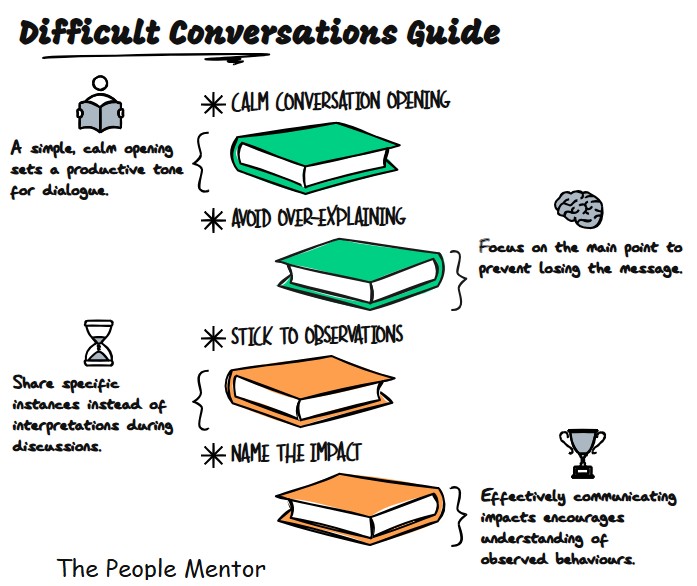
Most managers either over-explain – spending so long on context and caveats that the actual point gets buried, or they underprepare and open with something that immediately puts the other person on the defensive.
A simple, calm opening works best.
“I want to talk to you about something I have noticed recently. I want to share some specific observations and hear your perspective.”
That sentence does three things. It signals that this is a professional conversation, not a personal attack. It tells them you have specific examples, not just a vague feeling. And it makes space for their view which matters, because you may not have the full picture.
Then share your examples. Stick to what you observed, not your interpretation of why they did it. “In the team meeting on Monday, you interrupted Sarah three times” – not “you were being dismissive and arrogant.” The first is observable. The second is your interpretation, and it will be disputed.
Name the impact. “When that happens, it closes down the conversation. Other colleagues stop contributing because they are not sure their ideas will be well received.” Keep this factual and calm.
Then give them space to respond. This is the part most managers rush. They share the observation, name the impact, and then immediately move to what needs to change – without leaving room for the other person to say anything. Listen properly. They may have context you were not aware of. They may be defensive at first. That is normal. Give it a moment before you respond.
What to do when they get defensive.
Defensiveness is one of the most common responses to feedback, and it does not mean the conversation has gone wrong. Stay calm and stay specific. “I understand this might not feel accurate from your perspective. What I can speak to is what I observed.” You do not need them to agree that they were wrong. You need them to understand what you saw and what needs to change going forward.
What to do when they become upset.
Acknowledge it. “I can see this is difficult to hear.” Then give them a moment. Do not rush to fill the silence. If they need a short break, offer one. What you do not want to do is back away from what you came to say because the emotional temperature has risen. Compassion and clarity can coexist.
What to Do When the Conversation Does Not Go to Plan
Difficult conversations in the workplace do not resolve themselves. The ones you put off keep taking up space.
Sometimes the person denies it entirely. Sometimes they agree in the room and then nothing changes. Sometimes they become so upset that the conversation cannot continue productively.
Here is what to do in each situation.
They deny it. Stay specific. “I understand you see it differently. What I observed was this.” You do not need a confession. What you need is for them to understand clearly what you observed, that it matters, and what needs to change. Document the conversation afterward — what was said, what was agreed.
They agree but nothing changes. Follow up. This is the step most managers skip. Raising something and then not following up signals that it was not serious. Schedule a check-in two or three weeks later. Name specifically what you expected to see differently. If the behaviour has continued, say so clearly and refer back to the previous conversation.
The conversation becomes unproductive. It is okay to pause. “I think we both need a moment. Let’s come back to this tomorrow morning when we have both had a chance to think.” This is not avoidance — it is managing the process sensibly. Do come back to it. Set a specific time before you leave the room.
When to involve HR. If the behaviour is serious enough to warrant formal action, if the pattern has continued after multiple clear conversations, or if the person raises a counter-allegation, involve your HR team or an employment advisor before your next conversation. ACAS provides free, practical guidance on disciplinary and grievance procedures if you need a starting point. Document everything from this point forward.
Difficult Conversations With Your Boss - A Special Case
Raising something difficult upward is one of the situations managers find hardest.
The power dynamic is real. You are raising a concern with someone who has influence over your career, workload, and day-to-day work experience. That makes it feel riskier than managing a conversation downward.
But the principles are the same. Prepare your specific examples. Be clear on the impact. Know what outcome you are looking for. Frame it as a professional concern, not a personal complaint.
Where it differs is in framing. “I want to flag something that I think is affecting the team’s output” lands differently from “I have a problem with how you handled that.” Both might be accurate, but one opens a conversation and one opens a conflict.
For a full guide on this specific situation, the dedicated post on how to have a difficult conversation with your boss covers the preparation and language in more detail.
Building the Confidence to Have Difficult Conversations Regularly
Here is something I want to say directly: the managers who handle these conversations well are not a different kind of person from the ones who avoid them.
They have a method. They have practised it enough times that it feels less dangerous. And in many cases, they have had support — from a coach, a programme, or a mentor — that gave them the structure and the language to work with.
Confidence in difficult conversations is not a personality trait. It is a skill. And like any skill, it develops with the right framework and enough repetition.
If you are a manager who wants that support, here is what The People Mentor offers:
Making Difficult Conversations Easier is a three-month programme that gives you live, practical support to plan, structure and confidently deliver difficult workplace conversations. It is built for managers who know they need to have these conversations but want to go in properly prepared.
The Workplace Conversation Kickstart is the right option if you have one specific conversation coming up and you want focused, one-to-one support to prepare for it properly — what to say, how to open it, how to handle the response.
Conversations Catalyst Coaching gives you ongoing, one-to-one mentoring over three months if difficult conversations and challenging behaviours are a recurring pattern in your team rather than a one-off situation.
The Manager’s Academy is a membership programme for managers who want practical, ongoing support across the full range of people management challenges — difficult conversations included.
The right choice depends on what you are dealing with and what kind of support works best for you. If you are not sure, get in touch and we can work that out together.
Frequently Asked Questions About Difficult Conversations in the Workplace
How do I start a difficult conversation at work without it getting personal? The key with difficult conversations in the workplace is to open with an observation rather than a judgement.” “I want to talk about something I noticed in Tuesday’s meeting” is specific and factual. “I want to talk about your attitude” is a judgement that will immediately put the other person on the defensive. Stick to what you observed, name the impact, and leave space for their response.
What if the person gets upset or cries during a difficult conversation? Acknowledge what you see: “I can see this is difficult to hear.” Give them a moment. You do not need to rush on, and you do not need to fill the silence. If they need a short break, offer one. What you should not do is abandon the conversation entirely because emotions have risen – that leaves the situation unresolved and signals that an emotional response is enough to shut down a professional conversation.
How many times should I have the same conversation before escalating? In most cases, once clearly is not enough if nothing changes. A second conversation that references the first and names that the pattern has continued is usually appropriate. If the behaviour continues after two clear, documented conversations, it is time to move toward a more formal process and involve HR.
Do I have to have difficult conversations face to face? For anything significant – performance, behaviour, conflict – yes. Remote or hybrid working makes this harder, but a video call is far preferable to a written message for a high-stakes conversation. Written records are important for documentation, but the conversation itself should happen in real time, where you can read the other person and respond accordingly.
What Are the Main Types of Difficult Conversations at Work?Most workplace difficult conversations fall into a few categories: performance issues, behavioural or attitude concerns, interpersonal conflict between colleagues, and conversations about change or unwelcome decisions. Each needs a slightly different approach, but all benefit from starting with specific, observed facts rather than assumptions or character judgements.
How Do You Start a Difficult Conversation Without It Becoming an Argument?Open with a specific, factual observation rather than a judgement, then ask a genuine question and actually listen to the answer. Starting with blame or generalisations puts people on the defensive immediately. Starting with curiosity keeps the conversation collaborative rather than confrontational.
A Final Thought
Difficult conversations are not the worst part of managing people. Avoiding them is.
Every conversation you have had the courage to prepare for properly and deliver clearly has the potential to change something – in the other person, in your team, and in your own confidence as a manager.
The ones you put off keep taking up space. They affect your sleep, your team’s morale, and your credibility as someone your team can rely on to deal with things when they need dealing with.
You do not need to be perfect at this. You need to be willing to start.
If you want practical support to do exactly that, Making Difficult Conversations Easier gives you the framework, the language, and the live practice to walk into these conversations properly prepared.