
Written by Nicola Richardson, Founder of The People Mentor.
Nicola has spent over 40 years working with leaders and managers on the conversations that feel too hard to have, including this one.
This article explores what feeling undermined at work looks like, why it happens, and what managers, employees and small business leaders can do to address it, including how to start with the first conversation.
Key Takeaways from The People Mentor
- Feeling undermined at work is more common than most people realise, and it rarely resolves on its own
- Undermining can be obvious (being talked over, credit being taken) or quiet (being left out of decisions, having your judgement questioned in front of others)
- The first step is naming exactly what is happening, separately from how it makes you feel
- Small, early conversations are far more effective than waiting until you are at breaking point
- If the pattern continues despite you raising it, that is when it is time to involve your manager or HR
- Having the right words makes it significantly easier to address – most people avoid these conversations because they don’t know what to say
Feeling undermined at work creeps up on you. It is rarely one big moment. It is the meeting where your idea gets quietly claimed by someone else. The email where you are copied in after the decision has already been made. The comment that makes you sound less capable in front of the room, said with just enough smile that you cannot quite call it out.
If you are reading this because something has been nagging at you for weeks, you are not imagining it. And you are not overreacting.
This post will walk you through what undermining at work actually looks like, why it happens, and what you can do about it, starting today.
What Undermining at Work Looks Like
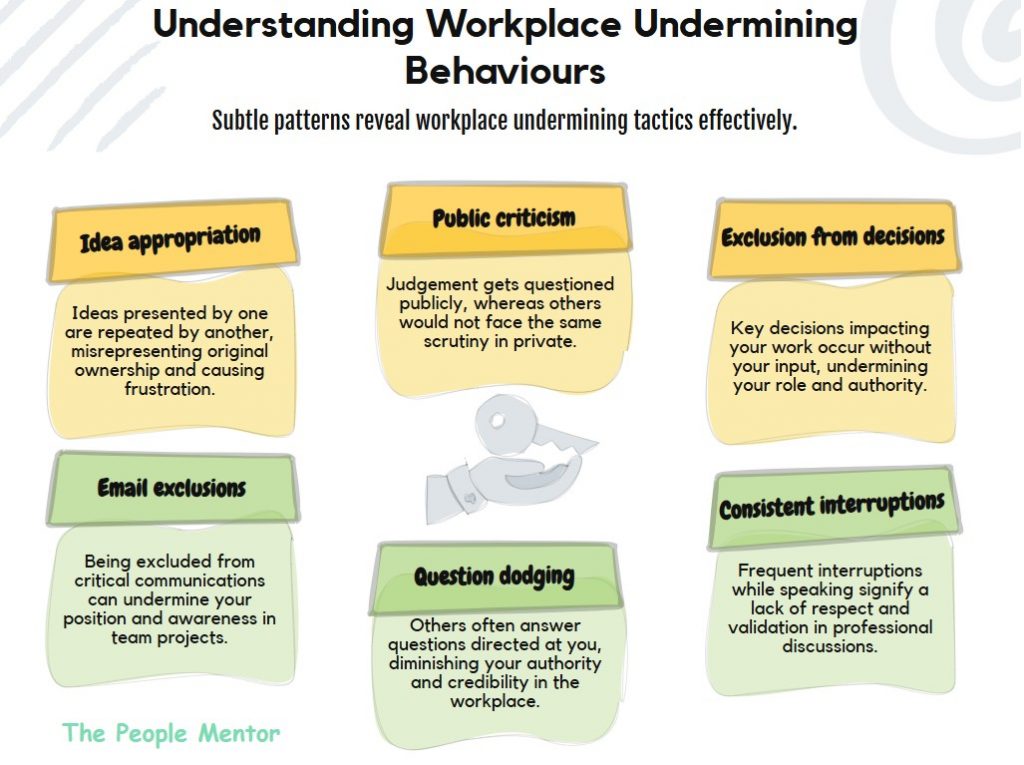
Undermining rarely looks like outright conflict. If it did, it would be easier to deal with. Most undermining behaviour is subtle enough that you can spend months wondering if you are being too sensitive.
Here are some of the most common patterns:
- Your contributions get repeated back by someone else in a meeting, and suddenly it is their idea
- Decisions that affect your work get made without you, then explained to you afterwards
- Your judgement gets questioned in front of others in a way it would not be if you raised the same point privately
- You are left off emails or invites that you would reasonably expect to be included in
- Someone consistently talks over you, or answers questions that were directed at you
Any one of these on its own might be nothing. A pattern of them, over weeks or months, is what feeling undermined at work usually comes from.
Why People Feel Undermined at Work
It helps to understand what is usually going on underneath this behaviour, because it changes how you respond.
Sometimes it is about insecurity. Someone who feels uncertain about their own position can undermine others, often without fully realising they are doing it, as a way of feeling more secure themselves.
Sometimes it is about control. If someone is used to being the one with the answers, your competence can feel like a threat to that, even when you have done nothing to challenge them directly.
And sometimes, it is simply about habit. Some people have never had to think about how their behaviour lands on others, because no one has ever told them.
None of this means you have to excuse it. But it does mean that in most cases, this is not really about you. It is about the other person’s relationship with control, recognition, or their own sense of competence.
At The People Mentor, I look at the pattern beneath the behaviour before assuming someone is deliberately causing harm. That reframe does not let anyone off the hook, but it does change the conversation you need to have.
Nicola Richardson
| What you may notice | What it could mean | What to do first |
|---|---|---|
| Your idea gets repeated as someone else's | Insecurity or habitual credit-taking | Reclaim it calmly in the moment |
| You're left off decisions that affect your work | Poor communication or deliberate exclusion | Ask directly to be included going forward |
| Your judgement is questioned publicly | Control or competition | Address it privately and specifically |
| You're consistently talked over | Habit, not always intent | Name it once, clearly and privately |
| Colleagues notice the same pattern | The behaviour is broader than you | Note who else has seen it, useful later |
What To Do When You Feel Undermined at Work
This is the part that matters most, so let’s get practical.
Start by naming it to yourself, clearly
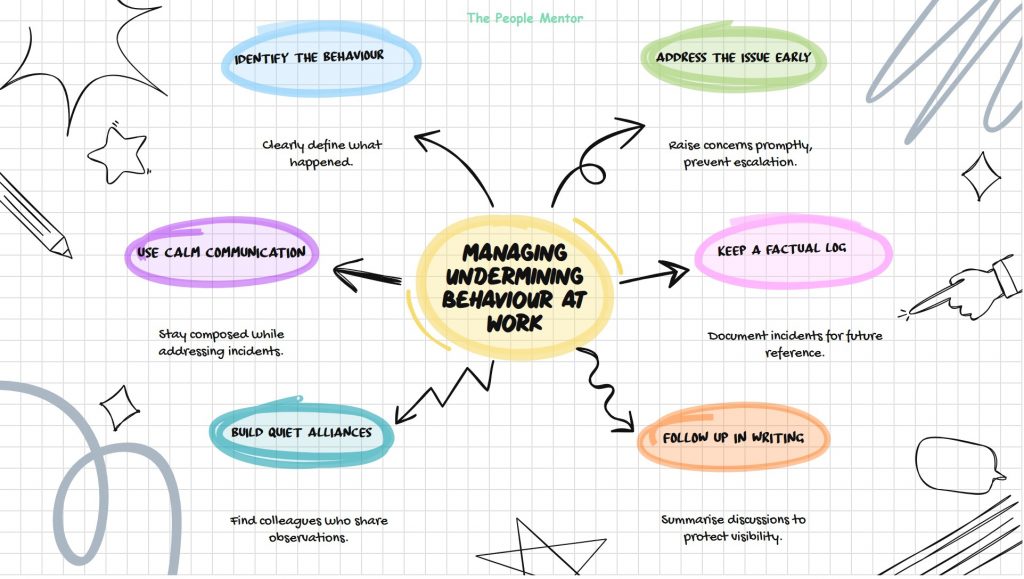
Before you do anything else, write down what has actually happened. Not how it made you feel, but what was said or done, when, and by whom. This matters because undermining behaviour thrives on ambiguity. If you cannot describe it plainly, it is much harder to address.
For example: “In the team meeting on Tuesday, I suggested we change the reporting format. Twenty minutes later, Sarah suggested the same thing and the manager said it was a great idea, without acknowledging I had said it first.”
That is specific. That is something you can work with.
Address it early, and address it directly
The earlier you raise something, the smaller it feels for everyone involved, including you.
If someone repeats your idea as their own, you do not need to make a scene. Something as simple as, “Glad you agree, that’s the point I made a few minutes ago, shall we go with it?” said calmly, does two things. It corrects the record without conflict, and it signals that you noticed.
If it happens repeatedly with the same person, a private conversation works better than letting it build. You might say something like, “I’ve noticed a few times recently that points I’ve raised in meetings get picked up by you afterwards as if they’re new. I wanted to mention it directly rather than let it carry on.”
Keep your own record
If the pattern continues, keep a simple, factual log. Dates, what was said, who was present. You are not building a case against anyone. You are protecting yourself, and giving yourself something solid to refer back to if you need to escalate later.
Build allies, quietly
You are probably not the only person who has noticed. Colleagues who have seen the same pattern can be useful, not for gossip, but because a manager hearing the same observation from more than one person carries more weight than a single complaint.
Protect your own visibility
If your contributions keep getting lost or claimed, start putting more of your thinking in writing. A short follow-up email after a meeting, summarising what was discussed and who suggested what, creates a clear record without needing to call anyone out.
When Feeling Undermined at Work Goes Too Far
When feeling undermined at work persists despite your efforts, it is time to take it further. Sometimes, despite your best efforts, the behaviour continues. If you have raised it directly, kept a record, and nothing has changed, it is time to involve your manager or HR.
When you do this, bring your factual log rather than a general sense of unease. “I feel undermined” is harder for someone to act on than “Here are four specific examples over the last two months, with dates.”
This is also where having outside support can make a real difference. When you are in the middle of feeling undermined at work, it is hard to see the situation clearly, and even harder to find the right words in the moment. Working through it with someone who is not involved in the situation can help you separate what is happening from how it feels, and prepare for the conversations that actually need to happen.
Undermined at Work - You Are Not Alone
Feeling undermined at work is more common than most people admit. The difference between those who resolve it and those who don’t is usually whether they act early or wait too long.
Most people wait. They hope it will pass. And sometimes it does. But the cost of waiting, to your confidence, your contribution, and your sense of self at work, adds up quietly in the same way the behaviour itself does.
The conversation feels hard until you have the right words for it. Once you do, it becomes something you can actually do.
Frequently Asked Questions
Is it normal to feel undermined at work sometimes?
Yes. Most people experience this at some point in their career. What matters is whether it is an occasional frustration or a repeated pattern. A pattern is worth addressing, even if each individual incident feels small.
What if the person undermining me is more senior?
The approach is the same, but the tone matters more. Keep it factual, keep it private, and focus on the impact rather than the person’s character. If a direct conversation does not feel safe, go straight to your own manager or HR with your record of what has happened.
Could I be misreading the situation?
It is worth considering, which is why writing things down factually helps. If you describe what happened and it still sounds like a pattern when you read it back, you are probably not misreading it. If a single incident, written down plainly, sounds minor, it might be worth letting it go and watching for whether it happens again.
If you recognise this pattern in your own workplace and want help working through it, Conversations Catalyst Coaching gives you the space to talk through what is happening, find the right words, and build a plan for the conversations ahead. Find out more about Conversations Catalyst Coaching.
For further guidance on workplace rights, visit ACAS