
Written by Nicola Richardson, Founder of The People Mentor.
The People Mentor helps small employers, managers and leaders handle difficult conversations, strengthen accountability and lead with calm, practical confidence.
I want to tell you about a registered manager I worked with a while back.
She was brilliant. Genuinely brilliant. Her residents loved her. Her staff would walk through walls for her. CQC had rated her service – Outstanding.
But the owner was on the phone to me every few weeks, quietly at the end of her tether. The manager’s supervision notes were always late. She responded to emails sporadically and sometimes not at all.
She struggled badly with last-minute changes to the rota and would become visibly dysregulated by them. When a difficult conversation needed to happen with a team member, she would circle it for days, sometimes weeks, before doing anything about it.
The owner kept asking the same question: ‘She clearly cares. She’s clearly capable. So why is this so hard?‘
Nobody had asked a different question.
What if this manager’s brain worked in a way that nobody had ever recognised, labelled, or properly supported?
What if the challenges showing up in her role were not personality flaws or capability gaps, but signs of undiagnosed neurodivergence?
That question changes everything.
The question nobody is asking in care
We have had many conversations in the sector about neurodiversity. And that is a genuinely good thing. Most of those conversations, though, are pointed in one direction: how do we support neurodivergent team members and front-line care workers?
That matters. I have written about it, and if you have not already, it is worth reading What Every Manager Needs to Know About Neurodiversity and Untapped Talent alongside Is Your Workplace Culture Actually Welcoming Neurodiverse People? for more on that side of the picture.
But there is a different question that almost nobody in care is asking, and it sits right at the level you are most focused on.
What if your registered manager is neurodivergent? And what if they do not know it?
Around one in five people are neurodivergent. That statistic does not stop at the carers and the front-line workers. It applies to your managers, too.
And in a sector where people are promoted predominantly because they were excellent practitioners, where management training is often thin, and where the job itself demands an enormous range of cognitive tasks simultaneously, undiagnosed neurodivergence in a registered manager is not a rare edge case.
It is something you may well be looking at right now, without realising what you are seeing.
What undiagnosed neurodivergence actually looks like in a registered manager role
The registered manager role is one of the most cognitively demanding jobs in any sector.
Think about what it requires:
- CQC compliance,
- safeguarding responsibilities,
- HR decisions,
- budget management,
- shift rota planning,
- family liaison,
- staff supervision,
- quality auditing,
- And leading a team of people in often pressured, emotionally charged circumstances.
All at once. Most weeks.
That is not a straightforward neurotypical job.
And when neurodivergence goes unrecognised, the gap between what someone is expected to do and how their brain is wired shows up in ways that are easy to misread.
Here are some of the patterns I see most often.
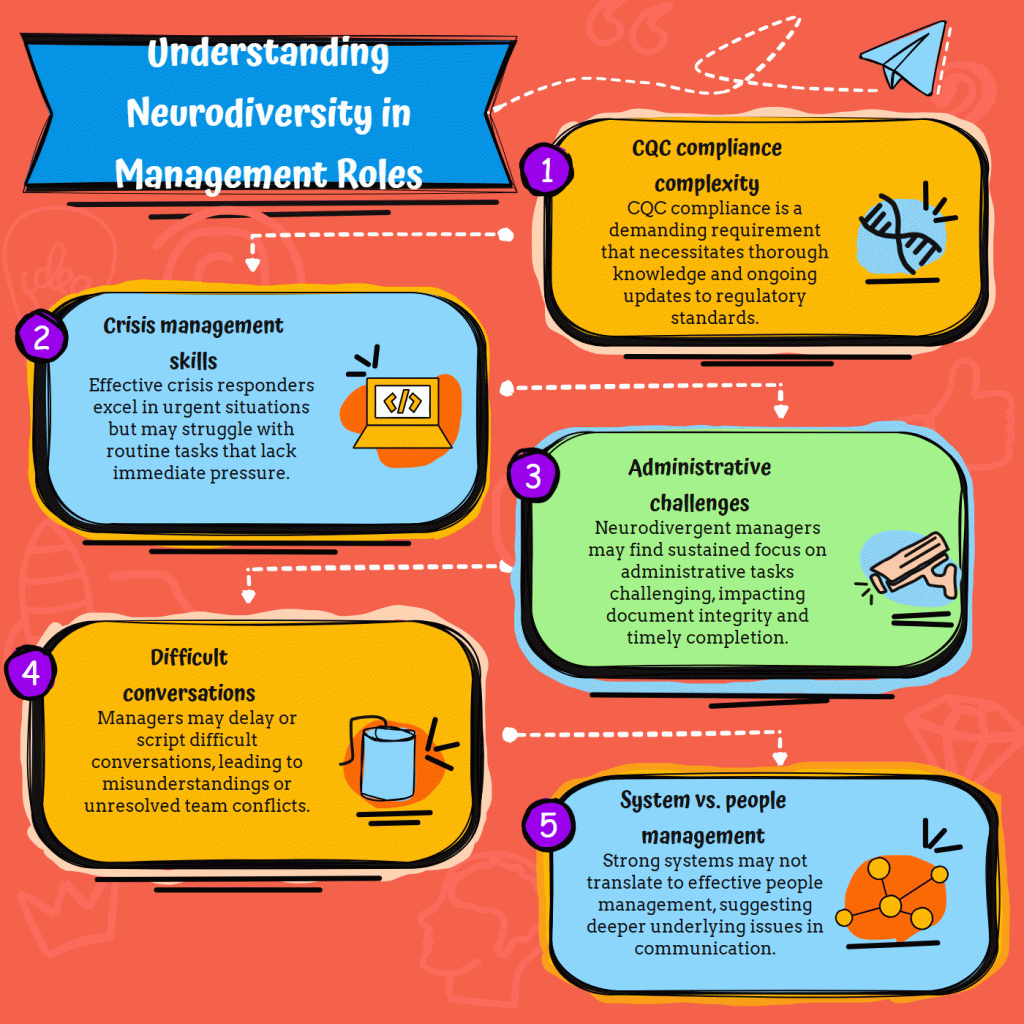
The brilliant crisis responder who falls apart in the routine
This manager is exceptional in the moment. When something goes wrong on a shift, she is calm, decisive, and absolutely in her element. Her instincts are sharp. Her judgment under pressure is sound. Staff trust her because she shows up when it matters.
But outside of the crisis? The routine is where it all unravels. Monthly audits go untouched until the last minute. Supervision records accumulate without being completed.
Admin tasks that require sustained, focused attention feel genuinely insurmountable, not because she does not care, but because her brain is wired for urgency. Without external pressure, internal momentum is lacking.
This is a very common ADHD presentation. And it often gets read by care owners as laziness, poor organisation, or a lack of professionalism. It is none of those things.
The process perfectionist who avoids the hard conversations
This manager has built exceptional systems. The policies are immaculate. The compliance folder is always up to date. The handover notes are thorough and well-structured. Shift to shift, the processes hold.
But when a team member is not performing, when a conflict has developed between two senior carers, when a family complaint needs to be addressed sensitively but directly, this manager goes very quiet.
The conversations are delayed. Sometimes avoided entirely. Or they happen, but in a way so scripted and carefully controlled that the team member leaves the room confused rather than clear.
Ambiguity is difficult. Social unpredictability is difficult. Conversations where the emotional outcome cannot be mapped in advance are genuinely hard. This can be an autistic presentation. Or it can be anxiety layered on top of neurodivergence.
Either way, the owner sees a manager who is strong on systems but weak on people management. That is only part of the story.
The passionate people-person whose paperwork is always a mess
This manager is warm, intuitive, and deeply connected to the people in her service. Residents and families feel genuinely held by her. She builds relationships with ease. She picks up on things that others miss. Her team feels seen.
But the documentation is a disaster. Reports arrive late and full of errors. Email responses are sporadic. Written communications are sometimes unclear or inconsistent, creating confusion further down the line.
This can be a dyslexia presentation, where the cognitive load of written output is significant and draining in ways others do not see.
It can also be dyscalculia when anything involving numbers and budget tracking is involved. And it almost always gets framed as unprofessionalism or a lack of attention to detail rather than what it actually is.
Why Care Owners keep Missing Neurodiversity
There are a few reasons this goes unrecognised, and most of them are completely understandable.
The first is that neurodivergent managers are often excellent at masking. By the time someone reaches a registered manager role, they have typically spent years figuring out how to function in a neurotypical world.
They have developed workarounds, coping strategies, and ways of appearing on top of things that they are quietly struggling with beneath the surface. The performance in front of you may look quite different from the internal experience.
The second is that care owners are looking at outcomes and risk, not at how a manager is functioning internally. You know whether the service is safe. You know whether there are CQC concerns. You know whether staff are raising issues.
What you often cannot see is the cost at which a manager is holding things together, the cognitive exhaustion, the anxiety about certain tasks, the way certain demands of the role feel genuinely disproportionate to how hard everything else feels.
The third is that the sector has a well-established pattern of promoting people for the wrong reasons. The capability cliff is real: the jump from excellent carer to registered manager is enormous.
When someone struggles in the management role, the working assumption is almost always that the promotion was the wrong call.
Sometimes that is true.
But sometimes the person has everything it takes to do the job, and what they are missing is the recognition that their brain works differently, and the support that would follow from that recognition.
There is also a fourth reason, which is harder to name. Historically, the care sector is not a place where neurodivergence is discussed at the management level. It is discussed as something that applies to clients and sometimes to front-line staff.
The idea that a registered manager might be quietly masking autism or managing undiagnosed ADHD while simultaneously holding responsibility for a complex care service is not a conversation that happens very often. It should.
What this Means for How you Lead and Support this Management Layer
If you are reading this and recognising someone, I want to be clear about what this is not.
It is not a reason to reduce your expectations of your registered manager. It is not an excuse for genuine underperformance. And it is not your place to diagnose anyone.
What it is, is a reason to look more carefully before you conclude that a manager lacks capability.
Have some honest conversations. Not ‘I think you might be neurodivergent’ conversations, but ‘I’ve noticed this is difficult for you and I want to understand what’s getting in the way’ conversations.
Ask what tasks feel hardest and which feel easiest. Ask what kind of support would help. Ask whether there are parts of the role that feel disproportionately draining compared to others.
And then really listen to the answers, because a manager who has spent years masking may not have the language yet to tell you what they need. They may not know themselves. But the patterns will be there if you are looking for them.
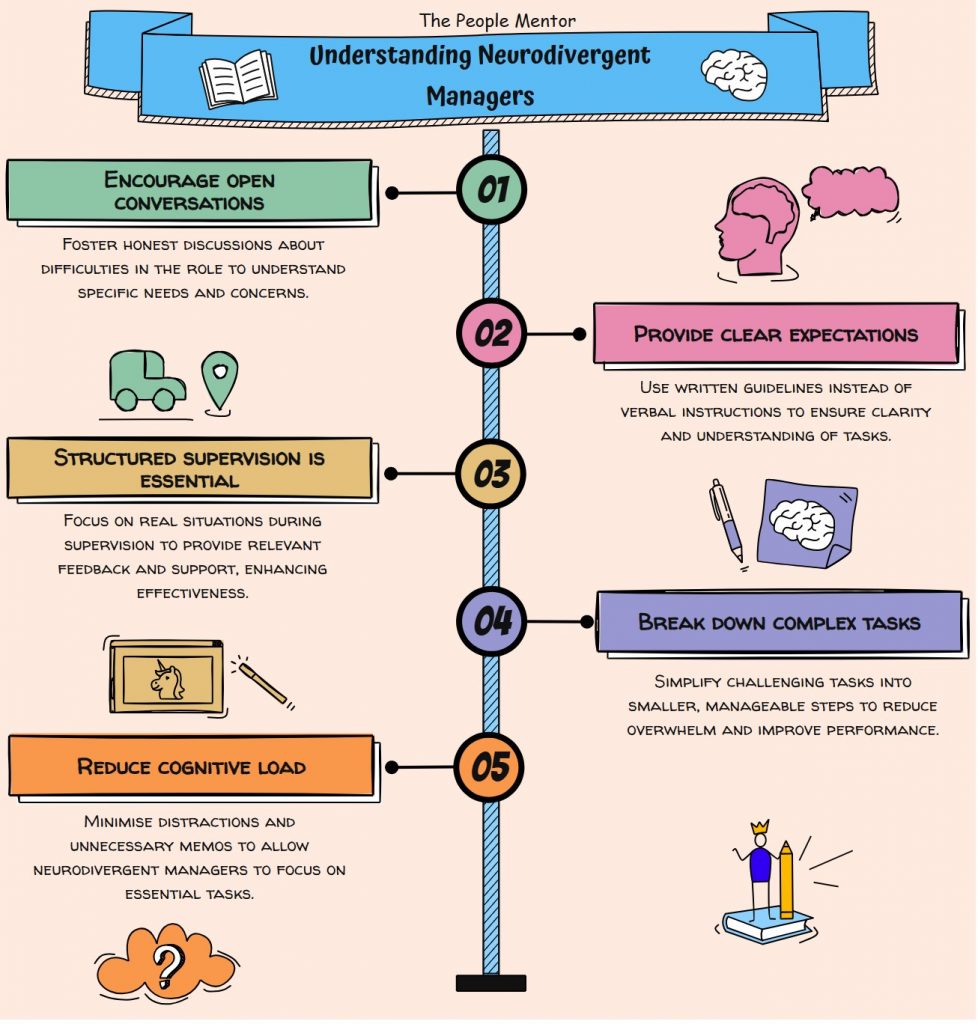
Some practical things that help neurodivergent managers function better in their role: clear, written expectations rather than verbal ones; consistent, structured supervision that focuses on real situations rather than paperwork reviews; breaking down complex tasks into smaller sequenced steps; reducing unnecessary cognitive load where possible; and not treating every late report or unfinished audit as evidence of a character failing.
These are, incidentally, good management practices for everyone.
But for a neurodivergent registered manager who has never been identified or supported, they can be the difference between quietly burning out and genuinely thriving in a role they are very capable of doing.
This is Not About Making Excuses with your Management Level. It is about making sense.
The registered manager layer is where your service is held or lost. I say that to every care owner I work with, and I mean it.
The consistency, the culture, the standard of care in the moments you are not there, all of it runs through that layer. If that layer is struggling, the consequences ripple everywhere.
Most of the time, when a registered manager is struggling, the conversation goes to performance management, capability frameworks, and ultimately to whether the right person is in the role. Those conversations are sometimes necessary. But they should never be the first conversation.
The first conversation should be a genuinely curious one.
- Why is this hard?
- What is going on?
- Is this someone who cannot do the job, or someone whose brain works in a way that the job has never been designed around?
You do not need to become a neurodiversity specialist. You do not need to have the clinical conversation yourself. But you do need to be a leader who considers the possibility before writing someone off.
Because the manager you are frustrated with might not be lacking commitment. They might just be working incredibly hard to hold things together in a way that nobody around them has ever fully understood.
And that deserves more than a performance review.
If you would like to talk through what this looks like in your service specifically or you want to book a virtual neurodiversity workshop specifically designed for people who manage teams, book a call.
The session is 40 minutes, practical, and comes with supporting resources and a follow-up video so the learning doesn’t stop when the session does., just book a call and let’s think it through together.
And if you want to read more abour Neurodiversity in the Workplace, here are three blogs to read –
Why Your Care Sector Staffing Crisis and Neurodiversity Have More in Common Than You Think,
Is Your Workplace Culture Actually Welcoming Neurodiverse People?
What Every Manager Needs to Know About Neurodiversity and Untapped Talent
Why not take the Care Business Risk Diagnosis? You can find it here.