

Written by Nicola Richardson, The People Mentor.
After more than three decades leading teams, Nicola founded The People Mentor to help employers tackle the conversations most managers spend years trying to avoid. Her COMPASS Conversation Model provides leaders with a practical structure that works.
This article looks at why underperformance takes such a toll on managers, what most advice gets wrong, and what actually helps, from the root causes to the first conversation and what comes after it.
This article looks at why underperformance takes such a toll on managers, what most advice gets wrong, and what actually helps, from the root causes to the first conversation and what comes after it.
If you are managing someone who is not performing, you will know the brand of tiredness that comes with it. It is not like being busy. It is not the tiredness of a demanding week. It sits differently. It follows you home. It is the constant low-level awareness that there is a problem you have not yet resolved, combined with the guilt that you should have addressed it sooner, combined with the dread of what addressing it might bring.
Managing underperformance is one of the most emotionally draining challenges a manager faces. And yet the advice most managers receive is almost laughably thin. Have a conversation. Set clear expectations. Follow the process. All correct in theory. None of it accounts for the fact that by the time most managers are ready to act, they are already running on empty.
This post is about why it gets so exhausting, and what genuinely helps, not just in terms of process, but in terms of how you think about and approach the situation differently.
Key Takeaways from The People Mentor
- The exhaustion of managing underperformance usually starts long before the formal conversation does.
- Vague feedback and unclear expectations are often a significant part of why underperformance takes hold.
- Curiosity before judgement is not softness. It is the most efficient route to understanding what is actually going on.
- Managers often absorb the work of underperformers rather than address it, which compounds the problem significantly.
- The first conversation should be informal and direct, not a tribunal. Most people do not know clearly what they are falling short of until someone tells them.
- What gets measured gets improved. Following through consistently, even when it feels like more effort, is what shifts the situation.
Where the Exhaustion Actually Comes From When Managing Underperformance
Most managers are not exhausted by underperformance itself. They become exhausted by everything they do to manage around it before they manage it directly.
There is the mental overhead of noticing problems and deciding not to act yet. There is the work of covering gaps, redistributing tasks, and quietly compensating for what is not being delivered. There is the monitoring, the hoping things will improve on their own, and the second-guessing of whether it is really that bad. And underneath all of that, there is the anticipatory stress of the conversation that has not happened yet but is never far from your thoughts.
By the time a manager finally acts, they have often been carrying this for weeks or months. And that accumulation is what makes the whole thing feel so heavy. The conversation itself is rarely as hard as the period leading up to it.
I see this pattern consistently in my work with managers. They are not unkind people. They are often accidental managers who were promoted without being trained in how to handle these situations, and so they manage the anxiety of it by avoiding, absorbing, and hoping. None of which makes things better. All of which makes things harder.
Before You Assume the Worst, Ask the Better Questions
One of the most useful things you can do before you frame a situation as an underperformance problem is to ask yourself what is at the root of it.
This is not about giving someone a pass. It is about being accurate, because the root cause shapes everything about how you respond.
There are four broad reasons why performance falls short. Work quality or output, including missed deadlines, errors, or volume of work that is consistently low. Communication issues, where someone is not keeping others informed, not asking for help, or not flagging problems early enough. Attitude and behaviour, where the approach, manner, or engagement has changed or is consistently problematic. And finally, reliability issues around attendance, punctuality, and doing what they say they will do.
Before you enter any conversation, be clear about which category you are dealing with. They are not all the same, and conflating them leads to confused conversations that do not land properly.
Also, ask yourself honestly:
- Were your expectations clear?
- Not clear to you.
- Clear to them.
- Specific enough that they could demonstrate they were meeting them.
Vague standards, informal understandings, and assumed knowledge are behind a significant proportion of underperformance situations I have worked through with managers. The person was not always failing to meet expectations. Sometimes they genuinely did not know what the expectations were.
The Hidden Cost of Absorbing Rather Than Addressing
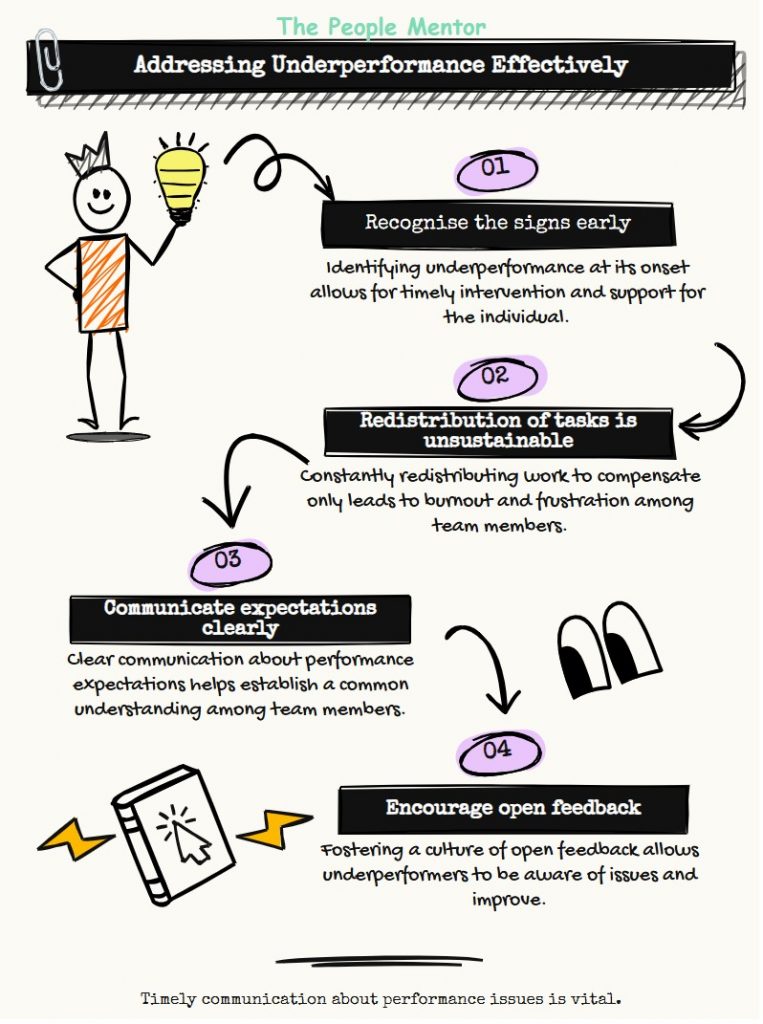
One of the most common responses to underperformance, particularly in smaller teams, is for the manager or other team members to quietly absorb the shortfall. The work gets redistributed. The gaps get covered. And the underperforming person continues, often unaware of the full impact they are having.
This creates several problems. The first is that it is unsustainable. The people absorbing the extra work eventually reach a point where they cannot carry it any further, and that is when things break down quickly. The second is that it signals to everyone else on the team that different standards are acceptable for different people. The third is that the underperformer is denied the chance to know there is a problem, which means they also have no chance to address it.
The real cost of this approach that rarely gets named directly. The manager ends up exhausted, carrying something that was never fully theirs to carry. The team gets quietly resentful. And the underperformer, when eventually told there is a problem, often cannot understand why it is only being raised now.
Addressing it early is not harsh. Having a clear, consistent performance management approach that everyone understands actually makes these conversations less loaded, not more. It removes the sense that someone is being singled out and replaces it with a shared understanding of how performance is discussed in this team.
What the First Conversation Should Actually Look Like
The most important thing to know about the first performance conversation is that it should not feel like a tribunal. It should feel like a direct, grown-up conversation between two people who both want the situation to improve.
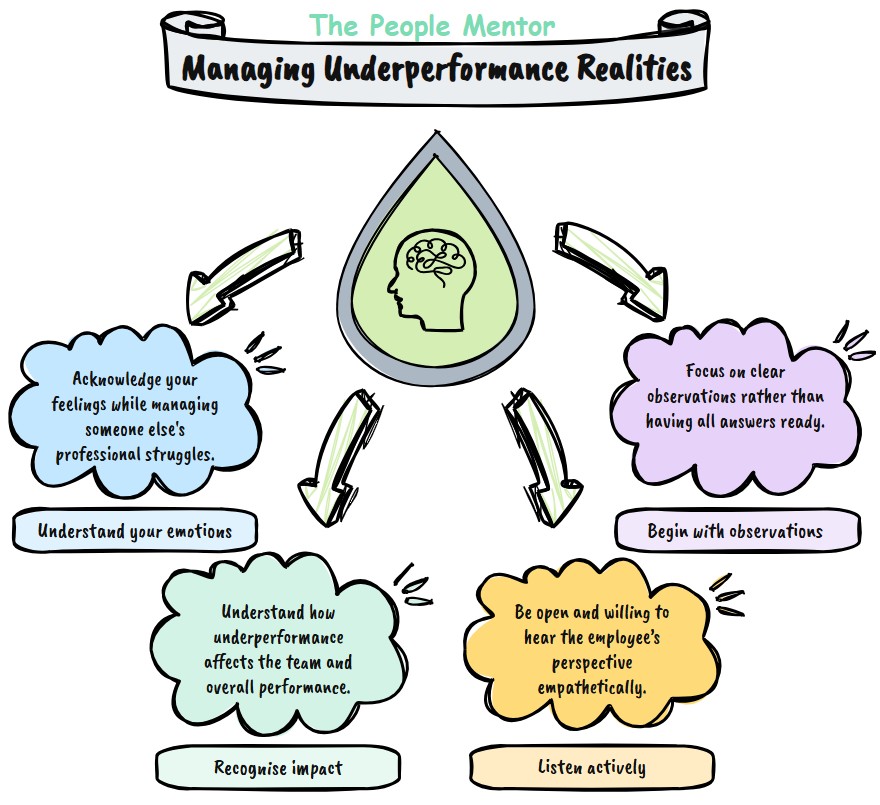
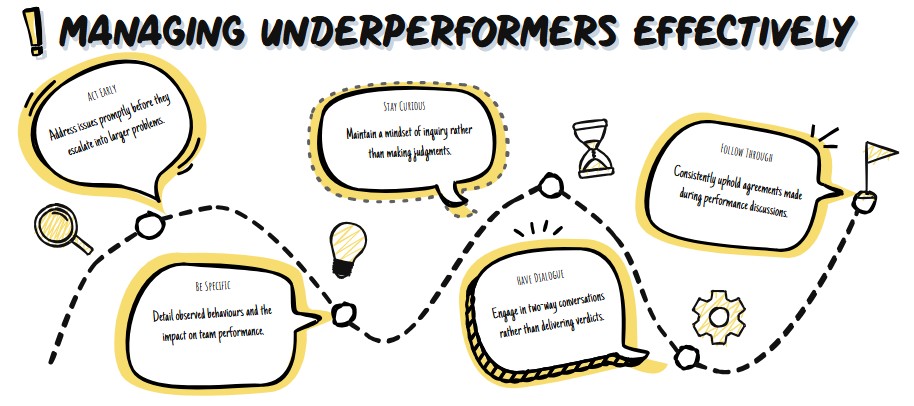
Keep it informal to begin with. The purpose of this first conversation is to open the issue, share what you have observed, explain the impact, and understand the person’s perspective. You are not there to deliver a verdict. You are there to start a dialogue.
A useful structure is to think in three parts. Start with what you have observed, using specific examples and factual language rather than general impressions or character judgements. Then explain the impact on the team, on the business, and on your ability to plan around them. Then move into a two-way discussion. Ask them what they think is happening. Ask open questions and listen properly to the answer. You might hear something that changes how you understand the situation entirely.
One phrase I come back to with managers is this: clarity is kindness. The more specific you are about what the issue is and what you need to see differently, the more the person can actually do something about it. Softening everything until the message disappears is not kind. It just means they leave the room not knowing what was actually being said, and nothing changes.
If you dread this kind of conversation, it is worth examining what story you are telling yourself about how it will go. In most cases, managers overestimate the difficulty of the conversation and underestimate how much the other person also wants a resolution.
| What makes it harder | What actually helps |
|---|---|
| Waiting and hoping it will improve on its own | Acting early, when the issue is still small, and the conversation is lighter |
| Absorbing the shortfall rather than naming it | Naming the gap directly and giving the person the chance to respond |
| Going in with a general impression of poor performance | Preparing specific examples with dates and observable facts |
| A one-sided download where you do all the talking | A genuine two-way conversation with open questions and real listening |
| Vague feedback like that wasn’t great or you need to do better | Specific, clear feedback tied to a behaviour and its impact |
| Assuming the worst motivation behind the performance | Staying curious about the root cause before reaching a conclusion |
| Following up inconsistently or letting agreed actions drift | Checking in consistently and holding the line on what was agreed |
What Happens After the First Conversation of Giving Feedback
The first conversation is not the end of the process. It is the beginning of it. And this is where many managers lose momentum, because following through consistently takes discipline, especially when the person seems to be making some effort, or when other priorities crowd in.
After the conversation, write down what was discussed and what was agreed. This does not need to be a formal disciplinary document at this stage, but you need a record. Be specific about what the improvement looks like, the timeframe, and when you will check in again.
Keep those check-ins. Do not let them drift. What gets measured gets done, and consistent follow-through sends a clear signal that this will not be managed around any longer. When you do see improvement, acknowledge it specifically. That acknowledgement matters, and it reinforces the direction you want to see.
If the informal conversation does not produce improvement, you then have the foundation to move to a more formal performance management process. That is not a failure on your part. It is the process working as it should.
The Part Nobody Talks About: Looking After Yourself Through Dealing with Underperformance Issues
Managing underperformance takes a toll on the manager. That is rarely acknowledged. You are dealing with another person’s professional struggles, managing your own emotional response to that, trying to be fair, worrying about getting it wrong, and still running everything else at the same time.
A few things are worth holding on to. First, you do not need to have all the answers before you start the conversation. You need a clear description of what you have observed, an understanding of the impact, and a willingness to listen. That is enough to begin.
Second, this does not reflect your quality as a manager. Underperformance happens in teams led by excellent managers and mediocre ones alike. What separates them is how it gets handled. Acting promptly, being clear, staying fair, and following through consistently is what good management looks like in this situation.
Third, you are allowed to find this hard. The discomfort of performance conversations is real, and it tends to diminish significantly once you have had a few and seen that most do not go as badly as you feared. The first one is always the hardest. The ones after that get easier.
Why This Feels So Hard for So Many Managers
There is a reason so many managers struggle with this, and it is not that they are weak or conflict-averse by nature. Most managers were never formally taught how to manage people. They were promoted because they were good at something else, handed a team, and left to work out the people management side for themselves.
Managing underperformance is a skill. Having a clear conversation about what is not working, staying factual, listening properly, setting expectations precisely, and following through without micromanaging. These are all things that can be learned. They do not come automatically, and their absence is not a character flaw. It is a training gap.
At The People Mentor, I work with managers who have been carrying this kind of situation for a long time, convinced that something must be wrong with them because they cannot seem to get it right. In almost every case, what they are missing is not willingness. It is structure. A clear way of approaching the conversation that gives them enough confidence to start it.
The Bottom Line of Managing Underperformance
Managing an underperformer is exhausting because most managers carry the problem for too long before they address it directly. They cover gaps, avoid the conversation, and absorb the weight of something that has not yet been named out loud. By the time they act, they are already depleted.
What helps is not complicated. It is acting earlier. Being specific about what you have observed and what the impact is. Staying curious rather than judgmental. Having the conversation as a dialogue, not a verdict. And then following through consistently on what was agreed.
That is not easy the first time. But it is learnable. And once you have done it once, it gets markedly less hard every time after that.
The most helpful thing you can do for an underperformer is to tell them clearly and fairly what is not working and give them a genuine chance to turn it around. That is not harsh management. That is honest leadership.
Want to get better at this?
Making Difficult Conversations Easier is a structured programme from The Manager’s Academy that gives managers the skills, frameworks, and confidence to have the performance conversations they have been putting off.
Find out more here or get in touch to talk through what your team needs.