This page explains what working with me actually involves: how we decide what your managers need, what a session is like, what happens in the weeks between sessions, what everything costs, and what I need from you for any of it to work.
Most training pages tell you what a programme covers and leave you to guess at the rest. You end up on a call still not knowing how many hours this will take out of your managers’ weeks, what happens if somebody misses a session, or what you keep when the work finishes.
So this page is the detail. If you would rather have the short version, book a call, and I will talk you through it in thirty minutes.
Key takeaways from The People Mentor
- There are five ways of working together, and the right one depends on how many managers you have and how deep the problem goes.
- Every session runs on situations your managers are actually dealing with, not on prepared examples.
- The weeks between sessions are when managers actually change how they handle things, so those weeks include bite-sized videos, templates and scripts, plus a community to post in.
- I publish prices for everything except bespoke workshops, which I price per enquiry. The People Mentor is not VAT registered, so you pay the quoted price.
- You keep the materials for internal use, we record virtual workshops, and we include a separate follow-up video to reinforce what the session covered.
How we work out what your managers need
Everything starts with a thirty-minute call, at no cost and with no obligation. I call it a virtual cuppa because it is roughly that length and tone.
On that call, I am trying to understand three things. What is actually happening with your managers, versus what the training request says. How long the pattern has been going on, because something that has run for two years needs a different kind of help than something that started when you restructured in the spring. And who else needs to take part, which is usually more people than an employer expects.
One request before that call. Please keep names and sensitive employee details out of it and talk in general terms. I can understand the situation well from a description, and keeping individuals out of a first conversation keeps everyone on the right side of confidentiality until an agreement is in place.
I will not give you a workshop price on that call. That may sound unhelpful, but here’s why. A one-hour session for eight managers and a half day for forty are different pieces of work with different preparation behind them, and quoting before I know which one you need produces a number that is wrong in one direction or the other. You will find everything that has a published price further down this page, so you are not in the dark while we talk.
If what you describe is not something I can help with, I will say so on that call and tell you what I think would help instead. Who I work with, and who I don’t, sets out the situations where I am the wrong person before you even book.
The five ways of working together
The Manager’s Academy
Who it suits: Employers who want their whole management layer developed month after month
What it involves: Two pop-in sessions a month where managers bring whatever issue is in front of them, plus one 60-minute training session a month built from what came up in those pop-ins, short bite-size videos in between, a self-paced hub, a library of templates and scripts, and Heartbeat, a private community where managers post what they are facing. CPD accredited
Making Difficult Conversations Easier
Who it suits: An employer putting one or two people through something substantial without an ongoing commitment
What it involves: A practical online programme with templates and frameworks, twice monthly live Team calls, a private community, and twelve months of access and support
Conversations Catalyst
Who it suits: One manager or leader facing something sensitive, recurring or genuinely complex, where group training is not the answer
What it involves: Six private 1-2-1 online sessions over three months. The first runs about 90 minutes and the other five about an hour. Includes a DiSC assessment.
The Leadership Conversations Partnership
Who it suits: Organisations where avoidance runs through the leadership team itself, not just one manager
What it involves: A twelve-month bespoke programme built from scratch around your organisation after a proper scoping conversation
Bespoke workshops
Who it suits: A specific group with a specific problem, or a team that needs a reset
What it involves: Virtual sessions from one hour up to four hours, or a series of shorter sessions across several weeks, built around your situation
If you are not sure which of the five fits, that is what the call is for, and it usually takes about twenty minutes to work out.
One thing worth saying about the Academy, because employers often ask. Once you have twelve or more managers, I can run sessions just for your own people. That is an option, not necessarily a better version. Many employers deliberately keep their managers in open sessions, because hearing how other organisations handle the same situation gives managers a wider view than hearing only from colleagues who already share their assumptions.
What a session is actually like
Sessions run on what people bring, rather than on scenarios I prepare in advance.
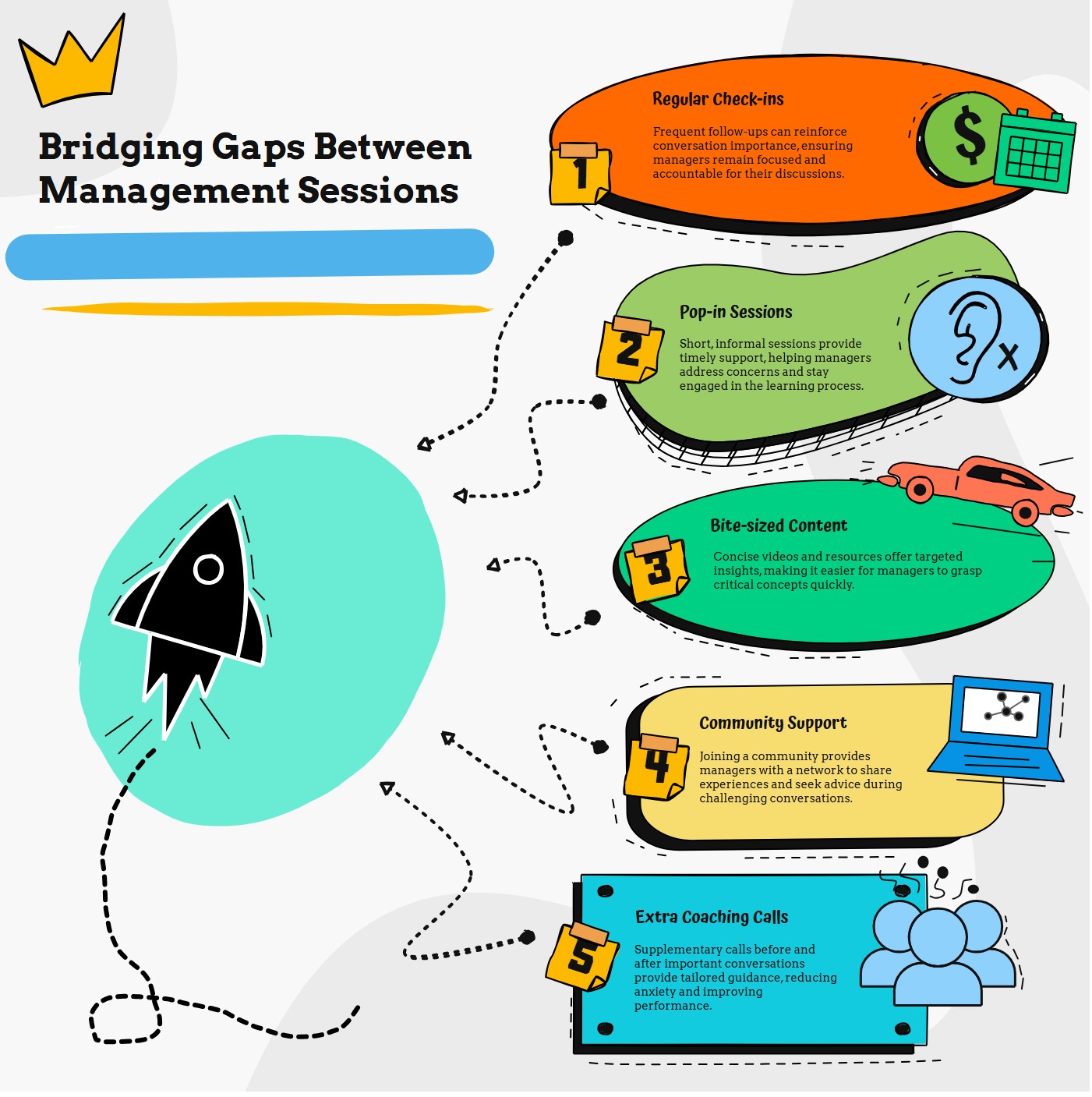
In The Manager’s Academy, that works across the month in three ways. Two pop-in sessions let managers bring whatever management issue is in front of them, and we talk through different ways to approach it. Then we have one training session a month, and the topic comes from the problems raised in the pop-ins and the discussions happening in Heartbeat, the Academy’s community space, where managers post what they are dealing with, and I share things worth knowing. In between, if those discussions show me people need more on something, I record a short, bite-sized video and add it.
So the training is not a fixed curriculum decided months in advance. It follows what your managers are actually dealing with, which is why they use it instead of filing it.
What happens in the room
That means a manager says out loud what is happening with a particular person, with enough detail for the rest of us to understand, no names needed, and we work out together what they are going to say.
What doesn’t happen is anyone having to act out the conversation in front of the group. Putting them on the spot like that silences the very managers who need the help most, and a session where people brace themselves for their turn stops being useful. Instead, they leave with a template to work from, so the words are on paper before they walk into the room.
I give people a structure to work from rather than a script to recite. The COMPASS Conversation Model has seven steps in order, starting with creating safety and ending with securing an action plan, so a manager preparing on a Tuesday evening isn’t staring at a blank page, wondering how to begin.
What you will not get is a day of me talking at your managers with slides. A prepared case study about a fictional employee teaches very little, because nobody is nervous about someone who doesn’t exist. The nerves are the useful part, and they only show up when the situation is real.
Where and how often
I deliver sessions online by default. In-person is possible by exception, not promised, and it adds travel and time to the quote.
Nobody has to attend everything. In the Academy, the training session is an hour a month, and the pop-ins are there for managers to use rather than attend religiously. Plenty of members only appear when a problem arises, which is exactly how I designed it to work. Live sessions run on varied days and times too, so the same people are not always the ones who cannot make it.
What happens between the sessions
This is the part employers ask about least and the part that decides whether anything changes.
A manager leaves a session intending to have the conversation. Then the week runs them over, they move the conversation to Thursday, and by the following Monday they have talked themselves out of it. Nothing in that sequence is unusual, and nothing about it is a failure of will. It is simply what happens when somebody faces something they find frightening on their own.
So the weeks between sessions need something, which is why I put things there rather than leaving a manager on their own with it. That gap is why most management training changes nothing, and it is the part I build around rather than bolt on.
What support looks like in each programme
In the Academy, there are two pop-in sessions a month, bite-sized videos I add when a discussion shows people need more on something, and a library of videos, templates, scripts, and frameworks they can reach for whenever they are preparing.
Making Difficult Conversations Easier offers twice-monthly live calls, a private community, and a full year of support, so someone who joins in February still has somewhere to go in October.
Conversations Catalyst goes further because I built it for one person facing something difficult. Alongside the six sessions, there are up to three pairs of extra thirty-minute calls, one before a conversation that matters and one afterwards, plus email or WhatsApp support in between. Someone can message me the day before and get an answer, which matters more than it sounds when you are rehearsing and worrying.
Your part in it
Somebody above your managers also has to ask how the conversation went. That costs you nothing, and employers skip it most often, often because of time and pressures. Asking isn’t about checking up on anyone; it is about whether the conversation mattered to anyone other than the manager who had it. A manager whose own manager never asks learns quickly that the training was a course, not a change.
What it costs
Here is everything with a fixed price. The People Mentor is not VAT registered, so these are final prices, not prices with VAT added at the end.
| Option | Price |
|---|---|
| The Manager’s Academy, 1 to 4 managers | £57 per manager per month, or £570 per manager per year |
| The Manager’s Academy, 5 or more managers | £45 per manager per month on a twelve-month commitment, or £450 per manager per year |
| The Manager’s Academy, 10 or more managers | Worth a conversation of its own |
| Making Difficult Conversations Easier | £295, including twelve months of support |
| Conversations Catalyst | £1,500, or three payments of £500 |
| The Workplace Conversation Kickstart | £225 |
| Mastering Emotional Conversations, self-paced | £27 |
| The Leadership Conversations Partnership | From £9,800 a year |
| Bespoke workshops | Priced per enquiry |
| The book, How to Make Difficult Conversations Easier in the Workplace | £11.99 |
The annual Academy rate is two months free, and you can cancel the monthly option at any time.
The smaller ways in
Not everyone wants to start at the top, and you shouldn’t have to spend much to find out whether this approach suits your people.
The Workplace Conversation Kickstart at £225 is focused support on one conversation that needs handling now. Your manager leaves with a plan, opening words, phrases for holding a boundary if the conversation turns, and a way to prepare that calms them down rather than winding them up. If you later move to Conversations Catalyst, we’ll take £100 off what you paid, so starting small costs you nothing.
Mastering Emotional Conversations at £27 is self-paced and can start today without waiting for a cohort. It is for managers who lose their footing when emotion turns up, whether that is the other person’s or their own.
The Management Exposure Check costs nothing. Fifteen questions, a score across five management risk areas, and an email report. It is the cheapest way to find out whether you have a problem worth spending on.
For an individual manager joining on their own, there is a fourteen-day free trial, with no payment taken until the trial ends. Employers get the same chance to look round first. You can spend fourteen days in the hub to see the templates, the library, and how the sessions actually run before you decide whether to put your managers through it. If you are buying for a group, it is still worth a short call so the live sessions can focus on what you are dealing with rather than a general curriculum.
Lead times
About three weeks for a single session, and about a month for a series. Longer if your procurement process needs it, which is normal for local authorities and worth raising early rather than late.
What you keep afterwards
The materials. Templates, scripts, frameworks, and tools are yours to use inside your organisation for as long as you want. They remain my intellectual property, so you can’t sell them or deliver them commercially, but no one will ask for them back when the programme ends.
The recording and a follow-up video. These are two different things, and you get both. When a workshop runs virtually, we record it, so anyone who couldn’t be there can watch the session. The follow-up video is separate and includes new material rather than a replay. I make it afterwards to embed what the session covered, and you can put it wherever your managers already look, whether that is an intranet or a learning platform. That helps the manager who needs a reminder a month later, and anyone who joins the team later.
Participation records, if you are using the Academy. It is CPD accredited and counts towards your managers’ annual CPD hours. For many employers, that is what gets the spend approved, because it is development you can evidence rather than training nobody can prove happened.
The option to deliver it yourself. If you reach the point where you would rather your own trainers ran this, I am open to licensing the materials for that. It is a separate conversation with its own terms, but the answer is not no.
The insurance details, if procurement needs them. Professional indemnity of £3 million each and every claim, and public and products liability of £1 million each and every claim, both with Hiscox. I can share certificates with the paperwork.
What I need from you
Three things, and none of them are unreasonable, but employers skip all three often enough to make them worth writing down.
Time that you have actually protected. An hour a month only works if nobody has quietly booked over it. A manager who attends a session with their phone face up, half watching a problem unfold elsewhere, gets very little from it, and that is a diary problem rather than an attitude problem.
The managers above the ones in training. If your senior people never ask how a conversation went, the training stays a course. I would rather involve them from the start than find out three months later that nobody was ever expected to use any of it.
Honesty on the first call. If the real situation is that one person has been difficult for two years and everybody has avoided it, say so. I have heard worse; I won’t judge your organisation for it, and the shape of the help changes completely depending on whether we are building general capability or dealing with something specific that everyone has left too long.
I don’t need your managers to be enthusiastic about any of this at the start. A fair number arrive resentful that someone sent them, and resentful is a perfectly workable starting point. What matters is whether they can bring a real situation into the room.
Final thought
This page runs long because most of what decides whether training works sits in the details, and brochures usually leave those details out. How often sessions run. What is there when somebody is struggling at ten at night. Who should ask how it went. What you are holding when the programme finishes.
At The People Mentor, I would rather you knew all that before you spent anything than find out later you bought something different from what you imagined.
If you want to see the thinking before you talk to anybody, why your managers keep escalating everything to you is about the pattern most employers notice first, and The Complete Guide to Difficult Conversations in the Workplace is the free version of a good deal of what I teach.
Talk it through with me
Book a virtual cuppa. Thirty minutes, nothing to prepare, no obligation to go ahead, and if what you need is not something I do, I will tell you on the call and point you somewhere better. Please keep names and sensitive employee details out of that first conversation, and talk in general terms to keep everyone on the right side of confidentiality.