Written by Nicola Richardson, Founder of The People Mentor. The People Mentor helps small employers, managers and leaders handle difficult conversations, strengthen accountability and lead with calm, practical confidence.
This article explains why management training doesn’t work as often as it should, what the format has to do with it, and how to buy training that actually changes how your managers behave.
You’ve bought training before. Everyone came back pleased with it, said it was useful, and six months later nothing about the place had changed. So now somebody is suggesting you spend again, and you’re wondering why this time would be any different.
It’s a fair question, and the honest answer is that it might not be. It depends almost entirely on the shape of what you buy.
Key takeaways from The People Mentor
- Most training fails because of its format, not because your managers didn’t engage.
- A single day with nothing after it is the most common thing employers buy and the least likely to change anything.
- People go back to a workload that hasn’t changed, never practise, and within three weeks they’re doing exactly what they did before.
- What changes behaviour is repetition, real situations and support over months.
- A one-off session is still worth doing if that’s what you want, as long as you know what has to follow it.
- Five questions, asked before you commit, will tell you whether any provider’s offer will stick.
- Three months is the fair test rather than the day, and there is a dip around week four that a single workshop cannot catch.
What usually happens after a training day
The day itself normally goes well, which is the confusing part.
People turn up, they engage, somebody says something honest they haven’t said out loud before, and everyone leaves a bit lighter than they arrived. The feedback forms come back positive. You think, good, that was worth the money.
Then they go back to a workload nobody reduced to make room for any of it. The week runs them over. They put off the conversation they were going to have until Thursday, then until after the deadline, then until it’s too late to raise without it sounding odd. Nobody practises anything because no one sets aside time to practise, and no one asks whether they have.
Within about three weeks, they’re doing exactly what they did before. Not because they forgot, but because nothing around them changed to make the new way easier than the old one. The 3 Key Benefits of Training Managers in Your SME covers what you’re hoping to get. This post is about why you often don’t get it.
It isn’t your managers; it’s the format
When training doesn’t hit the spot, most employers conclude their managers didn’t really engage with it. Some weren’t interested. One or two were on their phones. Or that the managers were never going to change.
I get why it looks that way, but I’ve seen it happen too often to believe it. The same people who changed nothing after a workshop will change a great deal when the thing is built differently. So the problem lies in the format, not in them.
The reason is that handling a difficult conversation is a skill, just like driving. Somebody can explain very clearly how to open a conversation about poor performance, and your manager can understand every word of that explanation, and still not be able to open the conversation when the person is sitting in front of them. Knowing and doing are different things, and only knowing transfers from a day of listening. Nobody learns to drive from a lecture about driving.
There’s usually a second thing going on underneath, which is harder to look at. If your organisation has got into the habit of avoiding things, a training day won’t shift that on its own, because the people who went back are returning to a place that still quietly rewards saying nothing. How a Culture of Fear Takes Hold at Work is about how that sets in.
None of this means training is a waste of money. It means a day of being told things, on its own, was never going to be enough, and buying another one won’t fix it either. Why Employers Should Invest in Difficult Conversations Training makes the case for spending on this at all. What follows is about spending on it well.
What you may notice, and what it could mean
If you’ve bought training before and you’re not sure why it didn’t take, this is usually where the answer sits.
| What you may notice | What it could mean | What to do next |
|---|---|---|
| Great feedback on the day, nothing different a month later | There was nothing after the day to carry it | Ask any provider what happens in weeks two to twelve |
| Your managers can explain the theory but still don’t do it | They were taught about the skill rather than taught the skill | Look for practice time, not more content |
| One or two changed and the rest didn’t | The ones who changed already had support around them | Involve the managers above them, not only the ones being trained |
| They say they haven’t had time to use it | Nothing was taken off them to make room | Agree what gets dropped before the training, not after |
| The same problems keep arriving at your door | Nobody below you is expected to handle them yet | Read why your managers keep escalating everything to you |
| It only sticks while the trainer is still around | The habit never transferred to your own managers | Ask who owns it once the provider has gone |
The four things that make training stick
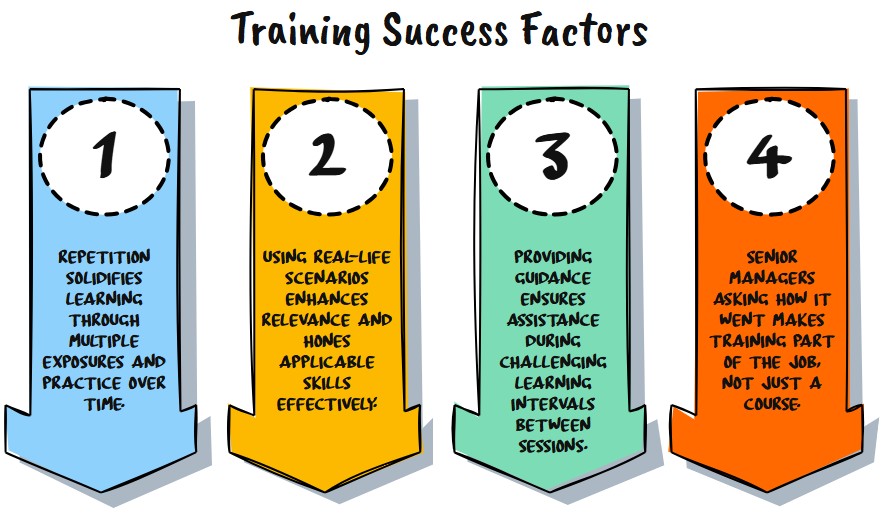
Across forty years I’ve seen management development work and I’ve seen it sink without trace. The difference comes down to four things, and a programme missing any one of them tends to struggle.
Repetition
Being shown something once is exposure rather than learning.
People need to come back to the same thing several times, with gaps in between where they’ve tried it and it hasn’t gone to plan. That’s the bit that teaches. A manager who has had one go at a performance conversation and found it harder than expected is far more ready to learn than one who has only heard about it.
So look for months rather than a day, and for sessions spaced out rather than stacked together.
Real situations
A case study about a fictional employee called Dave teaches almost nothing, because nobody is frightened of Dave.
What changes things is a manager bringing the person they’re actually dreading, and working out what to say about the situation. The nerves are real, the stakes feel real, and what they take away is something they can use on Monday rather than a principle they’ll have to translate first.
This is the whole reason my own sessions run on what people bring rather than on prepared scenarios.
Support between sessions
The gap is where it falls apart. That’s also where the learning actually happens, so the gap needs something in it.
Something to follow helps enormously, which is what the COMPASS Conversation Model is for. Seven steps, in order, so a manager preparing on a Tuesday evening isn’t starting from a blank page. But they also need somewhere to take the conversation that went sideways, before they decide they’re no good at this and stop trying.
Somebody above them expecting it
This is the one employers skip, and it costs more than the other three put together.
If a manager comes back from training and nobody ever asks them how the conversation went, they learn something very quickly: this was a course, not a change. Whereas if their own manager asks about it in their next 1-2-1, and keeps asking, it becomes part of the job.
That costs you nothing. It just has to be decided on beforehand rather than hoped for afterwards. The Importance of Training Managers to Deal with Conflict is an older piece of mine on why this matters so much, and very little about it has changed.
I built a training plan for an operational department once, and the part that made the difference wasn’t the training itself. The difference came from writing down what the training journey actually was, what would happen at each stage, and what people should expect to get out of each piece of training. We had been through years where none of that was ever clearly defined, so nobody quite knew what they were supposed to be getting.
Two things in that plan did the real work. The first was saying that evaluating a piece of training carried on for at least three months afterwards, rather than finishing with a feedback form on the day. The second was putting that three month review into managers’ regular 1-2-1s, so checking whether the training had been used became a normal part of a normal meeting rather than a separate task somebody had to remember.
Then I walked the managers through the plan rather than emailing it to them, and we put the training plan on the agenda of the management team calls so it came up month after month. That last step is what embedded the whole thing. Training that the management team discusses every month is training that people expect to be asked about, and a plan that only ever arrives as an attachment is a plan nobody reads twice.
So should you ever buy a one-off workshop?
Yes, sometimes, and I’d rather say that plainly than pretend otherwise.
It isn’t what I lead with, but if a single workshop is what you’ve asked for, I’ll run it, and I’ll be honest with you about what it will do. A good session can shift how a group thinks. It can give them a framework and some shared language. Most usefully, it can create the permission to start having the conversations they’ve been avoiding, which is sometimes the only thing standing in the way.
It also doesn’t have to end when the session does. I include a follow-up video if you want one, to put wherever your managers already look. That covers the people who missed it, anyone who joins later, and the manager who needs reminding a month on.
What a single session won’t do on its own is change habits. Habits need practice and follow-up, so I’ll tell you what would need to come after it to make it stick. Then you can decide whether to do that part now or later.
Less exciting to buy, considerably more likely to work.
If you want to know what I won’t take on, who I work with and who I don’t sets that out.
How to buy management training that changes something
You don’t need to know the subject to judge the offer. Ask any provider these five questions, including me, and the answers will tell you most of what you need.
- “What happens between the sessions?” A good answer describes something specific, such as practice tasks, a group to bring a live situation to, or somewhere to send a question when a conversation has gone badly. A poor answer is the word nothing, dressed up. If there is nothing between the sessions, you are buying a day out with a workbook.
- “Will my managers practise on their own real situations, or on examples you’ve prepared?” Prepared examples are far easier to run, and they teach much less, because nobody is nervous about a person who doesn’t exist. A good answer explains how people bring their own situations and what happens to confidentiality when they do.
- “How will we know in three months whether this worked?” Listen for something observable: fewer issues reaching you, conversations happening earlier, managers handling things they used to pass up. A provider who answers with attendance numbers or feedback scores has told you they measure the day rather than the change.
- “What do you need from us for this to work?” Anyone who says nothing is either very confident or hasn’t been doing the work very long. The honest answer involves your time, and usually involves the managers above the ones being trained, because somebody has to keep asking.
- “What won’t this fix?” The most useful of the five, and the one that tells you whether you are being sold to. Everybody’s work has edges. A provider who can name theirs has thought about where they help, and a provider whose offer fixes everything has thought about the sale.
You’re not looking for clever answers. You’re listening for whether somebody has thought about what happens after everyone goes back to their desks.
What the first three months should look like
Most employers judge training on the day and then stop watching, which is roughly like judging a diet on the first morning. Three months is a fairer test, and here is what a programme that is working actually looks like across those three months.
Weeks one and two
Your managers should be having conversations they would previously have put off. The conversations will not go brilliantly, and that is not a problem. What matters is that they happen, and that somebody hears how they went.
This is also the fortnight where good intentions usually die quietly, so this is where you ask. One question in a 1-2-1, which is “what have you had a go at since the session?”, does more than any amount of encouragement beforehand.
Weeks three to six
Expect a dip. People who have tried something new and found it uncomfortable often go back to the old way for a while, and some will decide privately that the approach works for other people but not for them.
A programme with support built into this stretch catches that dip. A single workshop has no way of catching anything, because by week four everyone involved has moved on to the next thing.
What you are watching for as the employer is whether issues are being raised earlier than they used to be. Earlier is the first real sign of change, well before anything looks tidier.
Weeks seven to twelve
This is where you find out whether a habit has formed. By now, handling something directly should be the normal first move rather than the brave option, and your managers should be bringing you fewer problems and more decisions they have already taken.
This is also when evaluating the training is genuinely worth doing, rather than on the day when everybody is still warm from the session. Ask three questions: what have you used, what did you avoid using and why, and what do you still not feel able to do. The third answer tells you what to buy next, if anything.
What to do if none of that happens
If three months have passed and nothing has shifted, the useful question is not whether your managers tried hard enough. Ask instead which of the four things was missing. Almost always it is the fourth one, because nobody above them ever asked, and that is the cheapest of the four to put right.
Final thought
If your last round of training changed nothing, that tells you something about what you bought. It doesn’t tell you anything about your managers, and it certainly doesn’t mean training can’t work here.
Most of what makes the difference isn’t the content. It’s repetition, real situations, something to lean on between sessions, and somebody above them who expects it to happen. Buy those four and the subject matter almost looks after itself.
At The People Mentor, I’d rather tell you what has to happen after the training than sell you a day and let you find out.
If avoidance is the pattern you’re seeing, why your managers keep escalating everything to you covers what it costs while it waits, and why you can’t make yourself have the conversation is about what stops a manager starting.
Talk it through with me
If you’ve spent money on training before and it didn’t take, book a virtual cuppa and we’ll work out what was missing. It’s thirty minutes, there’s nothing to prepare and no obligation to go ahead. Please keep names and sensitive employee details out of that first conversation and talk in general terms, which keeps everyone on the right side of confidentiality.