
Written by Nicola Richardson, Founder of The People Mentor. The People Mentor helps small employers, managers and leaders handle difficult conversations, strengthen accountability and lead with calm, practical confidence.
This article explains why your managers keep escalating everything to you, what that delay costs while problems sit and wait, and what you can do about it this week without buying a training programme.
You hired managers so that you wouldn’t have to deal with everything yourself. And yet here you are, being asked what to do about someone turning up late, someone else going quiet in meetings, and a falling out between two people who have worked together for years.
It’s easy to read this as managers who can’t cope. However, that is almost never what’s happening. Usually, something simpler is underneath, and it’s fixable.
Key takeaways from The People Mentor
- Managers escalate because nobody has drawn the line between what they decide and what you decide.
- The most common reason is simpler still. They haven’t been shown how to open the conversation.
- If you solve every problem brought to your door, you teach your managers to keep bringing them.
- The real cost is delay, because small issues harden into formal processes while they wait.
- One conversation with each manager tells you which of the three causes you’re dealing with.
- Confidence follows competence, so teaching the skill works far better than asking for more confidence.
Why managers escalate everything to you
In my experience there are three causes, and they often sit on top of each other.
They don’t know where their authority ends
Nobody has told them what they can decide on their own and what they genuinely need to bring to you. When that line hasn’t been drawn, the safest option is always to ask, so they ask about everything every time.
This one is quick to fix and employers often miss it, because the responsibilities feel obvious from where you sit. They aren’t obvious from where they sit. A manager who guesses wrong once will keep checking for a long time afterwards.
They don’t know what to say
This is the big one. A manager who has never been shown how to open a conversation about lateness, attitude or poor work will put it off. Bringing it to you feels like doing something about it, and it buys another week.
Most managers were promoted because they were good at the job, not because anyone taught them how to handle people. That’s not a character flaw. It’s a gap in what they were given. As a result, telling them to deal with it themselves rarely works, because the instruction doesn’t supply the thing they’re missing.
They’ve learned that you’ll take it
If every problem brought to your door gets solved by you, then handing problems over is working. People repeat what works. You may have trained this without meaning to, simply by being good in a crisis.
In practice, this one is the hardest to undo, because it feels unkind to stop. The first few times you hand a problem back, your manager will think you’re being difficult. That passes.
None of these three is solved by telling your managers to be more confident. Confidence follows competence, not the other way round.
What it is costing you
The obvious cost is your time, and that’s the one most employers notice first. It isn’t the expensive one.
The expensive cost is delay. A problem that gets passed to you doesn’t sit still while it waits. Someone who is coasting keeps coasting and watches everyone else notice that nothing happens. Someone being difficult gets another fortnight of being difficult. By the time the conversation finally happens, it isn’t a quiet word any more. It’s a formal process, with notes, witnesses and a lot of bad feeling.
There’s a second cost that’s harder to see. Every time you step in and sort it out, your manager learns a little bit more that this isn’t their job. Their team learns it too. People start going around their manager to get to you, because that’s where decisions actually happen. The manager you’re paying to run that team quietly stops running it.
And the people who are doing good work notice all of this. They see what gets tolerated. Some will decide the standard is low, and a few will leave.
What you may notice, and what it could mean
Use this to work out which of the three causes you’re looking at before you decide what to do.
| What you may notice | What it could mean | What to do next |
|---|---|---|
| Your manager checks things with you that they could decide themselves | The line between their authority and yours has never been drawn | Write down five real decisions they can make without asking you |
| The same person is raised with you again and again | A conversation was started, then softened until nothing changed | Ask your manager what they actually said, in their own words |
| Problems reach you fully formed rather than early | Your manager doesn’t know how to open an early conversation | Give them a structure to follow and let them use it |
| Team members come to you directly, going around their manager | People have learned that decisions get made with you | Send them back to their manager, and tell the manager you did |
| A manager says they’ll deal with it, then nothing happens | They’re waiting to feel ready, and that feeling doesn’t arrive | Agree a date for the conversation and ask afterwards how it went |
| You’re the only person who ever delivers bad news | Nobody below you believes it’s their job | Hand the next one back and support them through it |
What stops it
Years ago I held a Team Leader Service role, and a good part of what I did there was keeping information moving properly between management and the team. I kept regular contact with people, held team meetings, and listened to what was being raised rather than waiting for it to arrive as a complaint.
It wasn’t complicated work. But very little came up the line that needed to, because most of it had already been dealt with where it started. Problems were small when they were handled, and people knew where to take them.
That’s the whole thing. Issues escalate upwards when there’s nowhere lower for them to go.
What to do about it this week
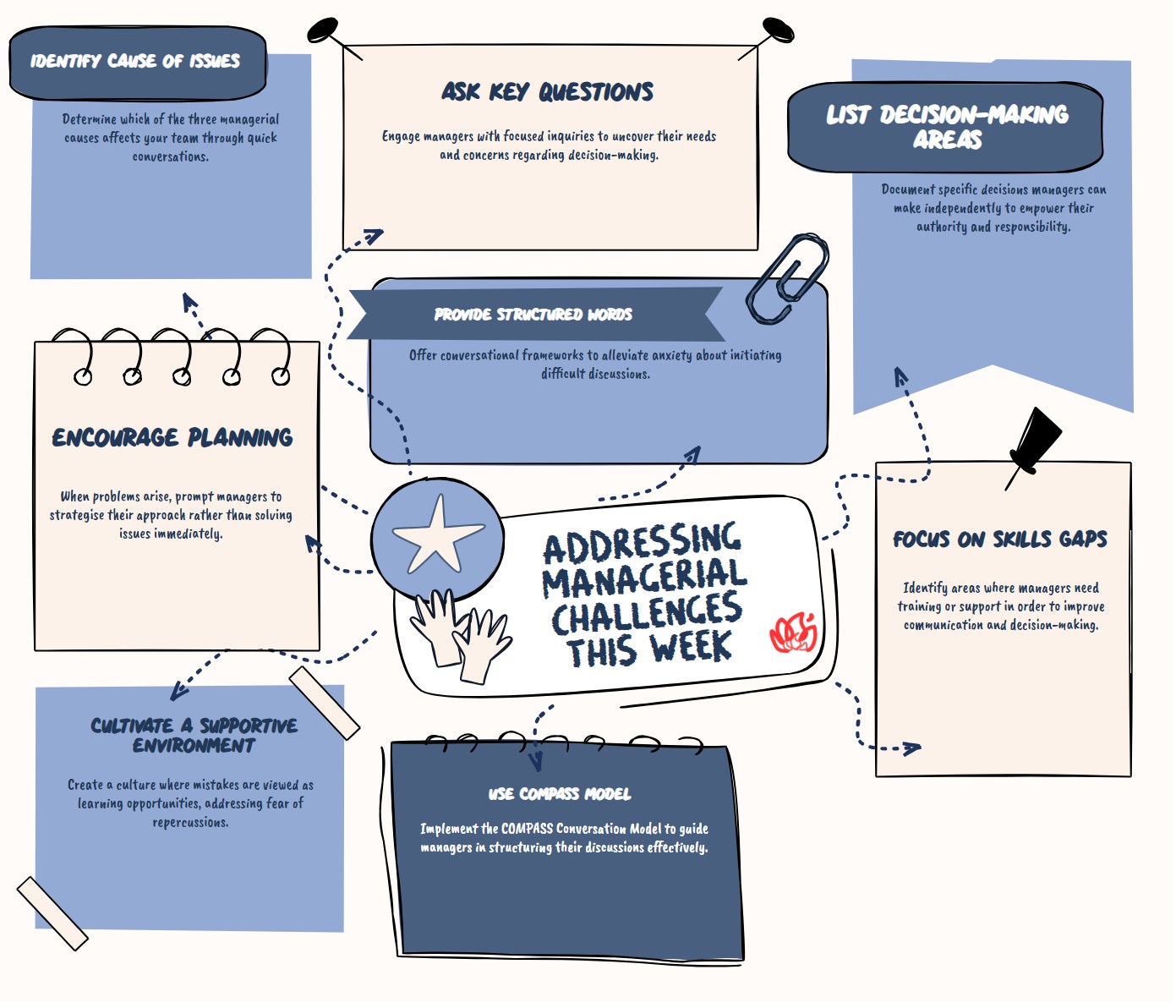
You don’t need a programme to start. You need to find out which of the three causes you’re dealing with, and that takes one conversation with each manager.
Ask them these four questions:
- “What sort of thing do you think you need to check with me before you act?”
- “Which conversation are you putting off at the moment?”
- “What would you need to feel ready to have it?”
- “What happens here if you get it wrong?”
The answers tell you most of what you need to know.
- If they list things you’d happily have them decide alone, the line hasn’t been drawn, and you can draw it in ten minutes.
- When they can name the conversation but not how to open it, that’s a skills gap and training will fix it.
- Where the fourth answer is about getting into trouble, you have something to look at in how mistakes get handled here.
Then do three more things.
- Write down what your managers can decide without you. Be specific. A list of five real examples beats a principle.
- When the next problem arrives at your door, don’t solve it. Ask what they’re planning to do, help them plan the conversation, and let them have it.
- Give them actual words. Most managers aren’t stuck on whether to say something. They’re stuck on how to open their mouth. A structure they can follow takes most of the fear out of it, and my COMPASS Conversation Model is there for exactly that.
Three things that make it worse
Employers who spot this problem often reach for one of these first. However, each one tends to deepen it.
Telling your managers to stop coming to you. Without the line drawn and the skill taught, this doesn’t stop the escalation. It only stops you hearing about it. The problems carry on out of sight until one of them arrives as a grievance.
Sending them on a one-day course. A day of theory with no practice and no follow-up changes very little. People go back to a workplace that still rewards avoidance, and within a fortnight they’re doing exactly what they did before.
Handling one yourself to show them how. This sounds generous, and it’s the most common of the three traps. The team watches you deal with it, so next time they wait for you again. Meanwhile, your manager has just seen somebody more senior do the thing they’re frightened of, which rarely makes it feel more possible. Practise it with them instead, in a conversation where nobody’s job is at stake.
None of this is quick to feel, so give it a few months before you judge whether it’s working.
If you want to go further, Why Managing an Underperformer is Exhausting covers what this does to a manager carrying it, How to Prepare for a Difficult Conversation You Can’t Avoid gives them something to follow, and How to Address a Negative Attitude on Your Team deals with the one that gets escalated most often of all. I wrote about why managers can’t or won’t deal with conflict some years ago, and very little about it has changed since.
Final thought
Managers who escalate everything aren’t failing. Instead, they’re telling you in the only way open to them that something hasn’t been set up yet. Either nobody drew the line, or nobody taught the skill, or they learned the habit because it kept working. Each of those sits with you rather than with them, and none of the three takes a year to change.
At The People Mentor, I look at what a manager hasn’t been given before I assume they aren’t up to the job.
Talk it through with me
If your managers keep bringing you problems that should stop with them, book a virtual cuppa. It’s thirty minutes, there’s nothing to prepare, and we’ll work out which of the three causes you’re dealing with and what would actually shift it. Please keep names and sensitive employee details out of that first conversation and talk in general terms, which keeps everyone on the right side of confidentiality.