In this episode of Bitesize Brilliance: Managing People, I talk to Mikulas Stubna, founder of Autismity. He builds virtual reality simulations that let people feel what a neurodivergent colleague feels in an open-plan office or a classroom. We talk about his brother, my grandson, the job I was told I’d be no good at, and why training people is pointless if the room they work in sets them up to fail. Listen to the full episode above.
Here’s a scene I’ve watched more than once. Someone is told they won’t be any good at a job. They don’t concentrate. They get distracted. So they move them somewhere safer, pass them over, or quietly manage them out.
It happened to me. I came to the top of the region in that job.
The job hadn’t changed. The fit had.
Key takeaways
- The environment sets the limit. You can train someone all you like. If their workplace drains them, you’ll never see what they can do.
- Experience beats information. Reading about sensory overload is not the same as feeling it. People change when they feel something.
- Most people won’t tell you. So stop waiting to be told. Build the trust that makes it safe and fix the environment anyway.
- Neurodivergent colleagues notice what everyone else is too busy to notice. Unclear instructions. Pointless work. Processes that don’t work.
- One size fits all. In real life, one size fits no one.
- Access to Work may pay for the help someone needs. Most managers I speak to have never heard of it.
In this episode, I talk about
- Why Mikulas built a virtual reality simulation for his brother, and then turned it into a business.
- What it feels like to sit in an open-plan office or a classroom when your brain takes in everything at once.
- Why my grandson walked out of school and didn’t go back for years.
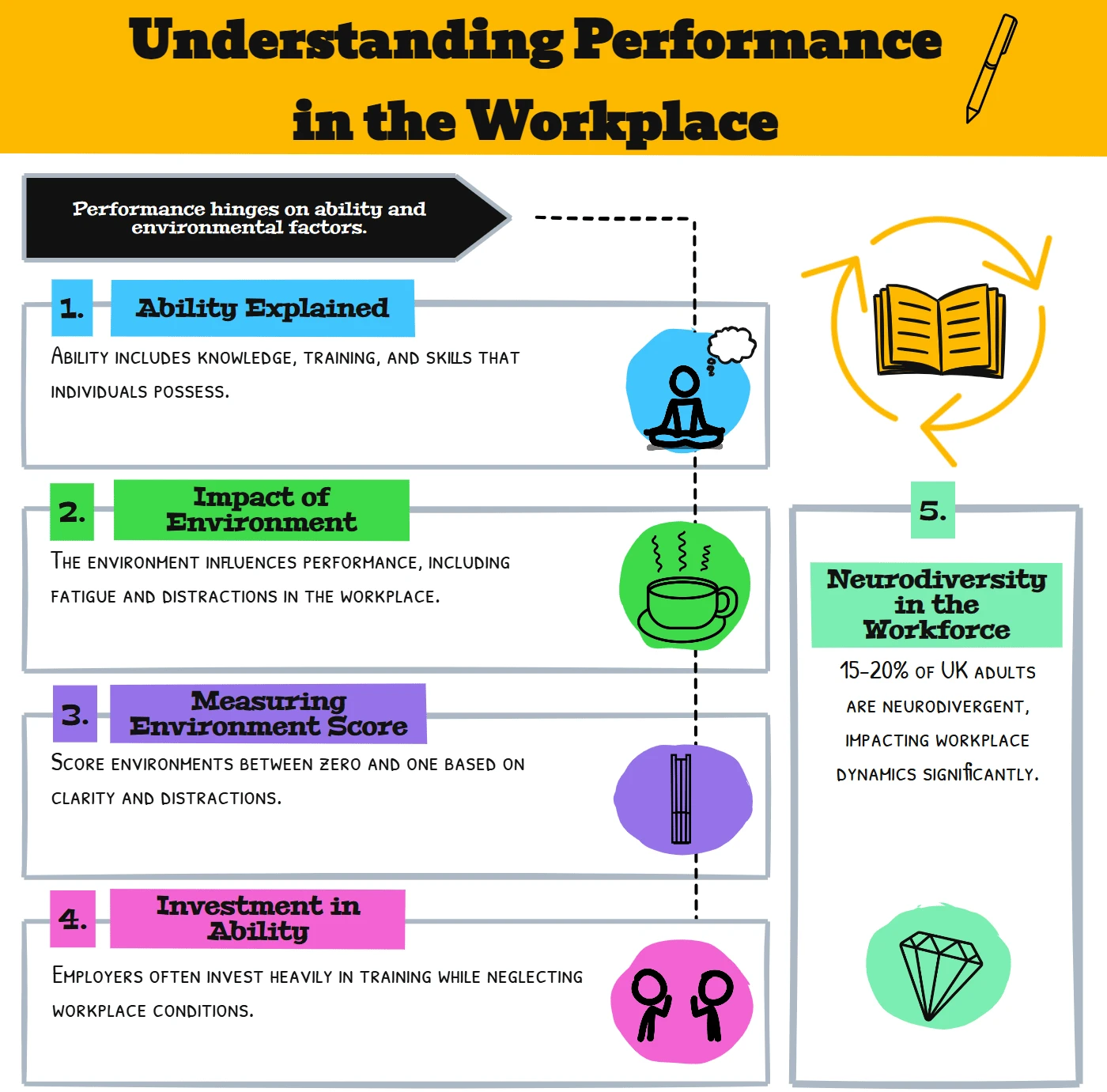
- The simple sum that explains why training alone never works: performance equals ability times environment.
- The job I was told I’d be no good at, and what happened when I did it anyway.
- Why so few people tell their manager they’re neurodivergent, and what builds the trust that changes that.
- Why your neurodivergent team members are your best early warning system.
A useful reframe
Performance equals ability times environment.
Ability is what someone knows and what they can do. But they can only reach it if the conditions let them. Most employers spend their money on ability. They spend almost nothing on the conditions.
The conversation
Mikulas runs Autismity. The name is autism and reality joined together, which nobody can pronounce, including me. The product is a virtual reality simulation. You put on a headset, and you spend a few minutes inside someone else’s senses.
I found him through the free resources on his website, and I’d recommend starting there if this is new to you.
Nicola: Your brother’s experience helped inspire this. What took you from that personal connection to actually building it?
Mikulas was honest about it. Part of the answer was that, as a young man at university, he wanted to build a business.
But he faced a real problem too. His brother is autistic and a year younger, so they’re close. His family also runs a national charity in Slovakia. When his brother finished school, the family hit something thousands of other families hit.
“He was frankly not ready for a job.”
What happens next, Mikulas says, is that young people often stay at home. They go backwards. Everything school put into them slips away. And the family pays too, because usually the mother gives up work to be there. That hits the money coming in, and it hits family life.
So the charity built a programme to help people find work, train for it and keep it. And one thing kept deciding whether it worked.
It wasn’t the person. It was the people already in the workplace, and whether they understood and accepted their new autistic colleague.
That’s where the headset came from. Mikulas’s team worked out that the best way to understand something is to experience it. So they put colleagues in the shoes of someone whose senses react far more strongly than theirs do. Someone who might cover their ears or ask for something that, in Mikulas’s words, sounds like an out-of-line request.
Nicola: Why virtual reality, and not a PowerPoint?
Because a PowerPoint tells you. A headset shows you.
Mikulas put it plainly. For the first time in history, you can step into somebody else’s reality, at least as far as their senses go.
So far, they have four settings: a coffee shop, a classroom, public transport, and an open-plan office. In the office one, you’re simply trying to concentrate, and you find out how hard that is.
I know that one firsthand. When I worked in a corporate business, they brought in an open plan, and everybody detested it. The noise. The constant interruption. Nowhere to put your attention. When you start building screens around people, at least you give them a bit of space that’s theirs.
Mikulas was clear about the limits, and I respect him for it. The simulation covers only two senses: sight and sound. A neurodivergent colleague will tell you that smell and touch matter just as much. It’s a window, not the whole room.
What noise cost my grandson
I’m surrounded by neurodivergent people in my family, and I don’t think most people realise how confusing and hard the world can be for them.
My grandson is coming up to 18. He was out of education for several years because he couldn’t cope with the noise, and I think with the emotions too. A maths teacher shouted at him. That was the end of it. He wouldn’t go back in again.
He’s now at college two days a week doing catering, and I’m incredibly proud of him, because that is a real achievement. But he still doesn’t socialise. He still finds it hard to speak to other people.
So put someone like that in your workplace. Other people look at him oddly. They don’t understand why he’s like that. Nobody is being cruel. They just don’t know.
Mikulas’s classroom simulation covers exactly this. You’re trying to listen to the teacher. But you can hear the people talking behind you, crystal clear. You can hear a pen moving on paper. Sunlight comes through the window. Objects on your desk aren’t lined up, and it bothers you, so you line them up.
And it isn’t only what’s in the room, is it? Bells go off down the corridor. People running past the door. All of that is pulling at you while you’re supposed to be concentrating.
One woman they worked with recalled a vivid childhood memory. A teacher called her out for not paying attention, walked over to her desk and stood right in front of her. She felt tiny. The teacher felt enormous. It happened to her again and again. Mikulas’s team built that feeling into the simulation so others would feel it too.
Nicola: So what should employers actually take from this?
Mikulas gave me the best answer I’ve heard on this, and he was honest that he picked it up on LinkedIn rather than inventing it.
Performance = ability x environment.
Ability is the easy part to see. It’s what someone knows, what they’re trained in, what they’re good at. Environment is everything that decides whether they can reach it. How tired they are. Whether the room is loud and how clear the instructions were.
Treat environment as a score between zero and one. If the office is distracting, the brief is vague, and the person is worn out, that score is low. So their performance is low. Their ability never changed.
Now look at where the money goes. Employers pour money into ability. Training courses, qualifications, development plans. They spend almost nothing on the conditions that let any of it show.
Mikulas summed up the whole problem in one line. One size fits all, but in reality one size fits no one.
This is also why the talent argument matters more than the kindness argument. When Mikulas and I recorded this, the figure most people quoted was that fewer than one in five autistic people were in work. That came from the first time the Office for National Statistics counted it, back in 2020, when the rate was 21.7%. It has improved since. The most recent government figures put it at around a third of disabled autistic people in work, against roughly eight in ten people who aren’t disabled. Better. Still the worst outcome of any group.
Meanwhile, ACAS estimates that somewhere between 15% and 20% of UK adults are neurodivergent. So this is not a small group of people on the edge of your workforce. It’s roughly one in six of the people you already employ.
I’ve written before about what every manager needs to know about neurodiversity and untapped talent, and about why a staffing crisis and neurodiversity have more in common than you’d think. The short version is this. If you can’t fill your vacancies, and there’s a large group of capable people who can’t get work, those two facts are connected.
The job I was told I’d be no good at
I’ve never been diagnosed with anything. But this conversation took me straight back.
I worked on county court debt collection for quite a while. Before I went into it, they told me I wouldn’t be any good because I didn’t know how to concentrate. I was always listening to everything. Always getting diverted.
Then I did the work. I got completely absorbed in it. We came to the top of the region because I was really good at it.
They were wrong. They missed that I needed work that played to my strengths and interests. I love being a detective, and that job let me be one.
So we write people off without ever finding out what they’re good at. The more we understand people’s strengths and the more curious questions we ask, the more we learn. That’s true of everyone. It’s just more obvious with neurodivergent people, because their strengths are often further from the middle.
If any of that sounds close to home, you might want to read: your middle manager might be neurodivergent, and not know it.
My daughter, and what changed at 42
My daughter is dyslexic. At 42, she found out she’s also autistic.
She’d struggled at work for 15 years before that. She managed. But it was a struggle the whole way through. Only now, with the right tools and a better working environment, is she performing the way she always could have.
Fifteen years. That’s what a poor fit costs, and she bore most of it.
Here’s something many UK managers and leaders don’t know. There’s a government scheme called Access to Work, and it will help pay. If you’re a large employer, they’ll probably ask you to contribute. If you’re small, they may well cover the lot. It can fund software. It can fund coaching. If the whole organisation has a training need, they can consider that too.
So when someone tells you what they need, the answer is often not “we can’t afford that”. The answer is “let’s find out who pays for that”. I’ve set out more of the practical side in supporting neurodiverse employees: a practical guide for employers.
Nicola: Why don’t people just tell their manager?
Mikulas and I agreed completely on this one, and it’s the bit managers find hardest.
Most people don’t want to tell you. There are many reasons, and most are sensible.
Mikulas said the strongest sessions he’s seen are the ones where a neurodivergent person is in the room. Everybody goes through the simulation, so they all start from the same place. Then he hosts a conversation between that person and the group. People are genuinely curious. They ask real questions. They build an understanding of a real colleague, not a condition.
Without that person, he said, you’re talking about someone in the third person while they’re not there.
I’ve done the same thing from the other side. I ran a neurodiversity workshop for a company before I knew about Mikulas, and my autistic daughter presented as part of it. She told her own story. She shared her childhood, her adult life, her diagnosis, and how things changed once she had support. It was well outside her comfort zone, and I know what it cost her.
It worked because it was real and because the person was right there.
But Mikulas was careful here, and he’s right to be. Doing that in a workplace is sensitive, because people don’t want to disclose.
So if you want those conversations to happen, the work is yours, not theirs. You need to be understanding, approachable. and to build trust. You do that by keeping confidentiality. By taking what people tell you seriously. By doing your best to change the thing they’ve asked you to change.
And you don’t make a big thing of it, all about one person. I’ve seen that go wrong in workplaces. It’s about making work better for everyone.
Think about what people face when they consider speaking up. All it takes is one person whose view is “there’s no such thing” or “we never used to have it in my day”. Those beliefs, whether people say them out loud or not, stop others from ever opening their mouths.
Which means we have to look at ourselves first. I’ve written about whether the culture around you is genuinely welcoming in is your workplace culture actually welcoming neurodiverse people?
Nicola: What reactions have stayed with you?
A mother crying. Mikulas said it happens often, and it’s the strongest reaction he sees.
When they asked her about it afterwards, she said she had just felt what her son goes through every day. For the first time, she understood why he covers his ears in certain situations.
That must be very moving to watch. It also shows that it’s doing its job, because she couldn’t have understood that just by being told.
Mikulas explained why it sticks, and it comes down to how memory works. Your brain keeps what it decides is important, and emotion is how it decides.
His example was the stove. Your mum tells you not to touch it because it’s hot. That’s just information. Then you touch it and burn your hand, and your brain remembers for the rest of your life.
An extreme example, as he said. But it shows the link between feeling something and remembering it.
This is exactly why I go on about storytelling at work. You can give people the facts, and they’ll forget them by Friday. Bring emotion into it, and they remember the story years later.
Nicola: How has working with people unlike you changed how you lead?
This was my favourite answer of the whole conversation.
Mikulas said he’s come to see neurodivergent people as a litmus test. Put something out into the business, and they’ll tell you whether it’s any good. Whether the process works, whether the instructions are clear, and whether the space is fit for its purpose.
His theory is that the reactions are often the same as everyone else’s. The intensity is different. They feel it more strongly, so they notice it sooner.
He gave me an example from the week before we spoke. A neurodivergent man was pushing back on a report he’d been asked to produce. He’d checked the view count. Nobody was reading it. So he asked his boss directly why he should spend three hours on something no one would read.
Mikulas said that man could feel it in his bones. He couldn’t make himself do work with no purpose.
Mikulas now uses a trick he learned from investor Charlie Munger, called inverted thinking. He learns from neurodivergent colleagues what makes something hard or pointless, then he flips it. In this case, he makes sure he can explain what a piece of work is for and how it connects to the result.
I loved that because I’ve lived it: I went in as an operations manager, and we were collating all this data. I asked who was reading it. Who was using it? Nobody knew.
So I said, right, we’re going to look at every single report we produce, and I want to know who it’s for and how often it’s used.
We got rid of half of them.
Neurodivergent people spot patterns and what’s going on under the surface, because the rest of us are too busy working to look up. That’s not a nice extra. That’s useful.
Another simple one I used for years. Put the goals and targets up on a flip chart. Then ask everyone to write how their own role contributes to them. People need to see the line between what they do and why, or none of it means anything.
Nicola: What do you wish you’d understood earlier?
Mikulas was careful with his words here, and I liked that. He wouldn’t say the company represents neurodivergent people, because he respects them too much to claim that. It tries to represent their experiences, and what those experiences mean in a room full of other people.
Then he answered straight. He wishes he’d involved neurodivergent people beyond the product.
His thinking had been too narrow. He built the simulations with them, which was right. But he now sees he should have involved them in how the company talks about itself, because the people who care about this work are often neurodivergent themselves and often the leaders in their organisation. And he should have involved them more in what happens after the headset comes off.
Because that’s the real question, and it’s the one his customers ask him. So what are we going to do about it?
Frequently asked questions
What is a neuro-inclusive working environment?
It’s built on the understanding that people’s brains work differently, so work needs to be set up to allow for that. Quieter space. Clear written instructions. Time to think before you expect an answer. None of it is complicated. It’s just rarely the default.
Do I need a diagnosis before I change anything?
No. Most of what helps is good management anyway, and it helps everybody. If someone tells you what makes their job harder than it needs to be, you can act on that today. Waiting for paperwork wastes months and tells the person you didn’t believe them.
What is Access to Work?
It’s a government scheme that can help pay for the support someone needs to do their job. That might be software, equipment or coaching. Larger employers usually contribute. Smaller ones may cover the full cost. It’s worth a conversation before you decide you can’t afford something.
What if someone doesn’t want to tell anyone?
That’s their right, and it’s very common. You can still fix the environment. Share agendas before meetings. Give instructions in writing. Reduce noise where you can. Ask everyone what a good working day looks like for them, so nobody has to single themselves out to be heard.
A final thought
Three things I took from talking to Mikulas.
The environment sets the limit, so training people and leaving the room unchanged wastes money. Most people won’t tell you what they need, so the trust has to come first. And the colleague who keeps asking awkward questions about why a piece of work exists is probably doing you a favour.
None of this needs a policy. It needs a decision, and then some conversations you may have been putting off.
If you’re not the one who gets to change the systems, you still have more influence than you think. I’ve written about that in how to influence your team when you’re not the boss.
And if you’d like help having these conversations properly, take a look at my virtual management workshops. They’re practical, run online wherever you are in the UK, and built for managers who want to know how to do this, not just why it matters.
Where to find Mikulas
Mikulas Stubna founded Autismity.
- Website: autismity.com
- LinkedIn: Mikulas Stubna
- Autismity is also on LinkedIn, Instagram and Facebook
Start with the free resources on the website. That’s how I found him, and they’re a good place to begin if you want to understand this better.
Sources
- Outcomes for disabled people in the UK: 2020, Office for National Statistics, for the 21.7% figure
- Autism policy and services: Employment, House of Commons Library, for the 2024/25 employment rates
- The employment of disabled people 2026, Department for Work and Pensions
- Bosses urged to do more to support neurodiverse staff, Acas, for the 15% to 20% estimate
Want support with this? Come and join The People Leaders’ Room