
Written by Nicola Richardson, Founder of The People Mentor. Most people problems in an organisation are conversations that never happened. I help employers and their managers have them properly, and sooner.
This article explains how to document workplace bullying as an employer when no single incident looks serious enough to act on, how to recognise a pattern of behaviour at work, and what you and your managers should be writing down so you can deal with a concern properly and fairly for everyone involved.
Key takeaways from The People Mentor
- Grievance procedures are built around incidents, so a pattern of behaviour at work slips straight through them.
- The frequency is the evidence. One sarcastic comment is a bad day, and fifty of them are a working relationship that is costing you something.
- A good entry holds six things: when it happened, when you wrote it up, where it happened and how you know, who else was there, what was said in plain words, the effect on the work, and what you did next.
- Most of what you record will be second-hand, so mark clearly what you were told and who told you, and never write it up as though you saw it.
- Three tests tell you whether this is a pattern, two people who don’t get on, or performance being managed: how often it happens, whether it only goes one way, and whether it changes when somebody else walks in.
- Write every entry as though the person it is about will read it, because they may well be entitled to
- Short written summaries after significant conversations, kept by every manager as standard, remove the selective memory problem long before you need them to.
Why employers find out too late
A capable manager hands in her notice. At her exit interview she says she is ready for a new challenge, and you believe her, because her file shows nothing to suggest otherwise. No grievance, no disciplinary, nothing flagged in four years. Then, eighteen months later, her replacement resigns too, and this time somebody mentions the director they both reported to.
That is how many employers find out, far too late to do anything useful. So if you want to know how to document workplace bullying before it costs you two good people and a reputation you cannot easily repair, you have to start with the thing your process is least equipped to see, which is a pattern of behaviour at work made up of incidents that each look like nothing.
What follows is what you and your managers should be recording, what to leave out, how to judge what you are looking at, and what to say to both people. Some of it is uncomfortable, so I would rather be useful to you than reassuring.
Why your grievance process cannot see a pattern
Most procedures are built around incidents. They ask what happened, when it happened, and who else was there, and they work perfectly well for a single event with a clear beginning and end. Someone shouted in a meeting. Someone sent that email. A formal process can capture that and act on it.
A pattern does not look anything like that. It is a remark in a corridor, information held back until the deadline has gone, an idea dismissed in March that turns up again in June with somebody else’s name on it. Any one of those can be explained away, and the person on the receiving end knows it, so they run the list through their head, fail to convince themselves, and decide they are probably overreacting.
So nothing gets reported. And the behaviour carries on because it costs nobody anything. The person adapts around it. They stop offering ideas. Decisions they are perfectly qualified to make get pushed up the line, because being thought slow is less painful than being corrected in front of other people.
Then they resign, and your exit process records that they wanted a new challenge.
That is an expensive way to find out. You have paid to recruit twice, lost knowledge you cannot buy back, and the three people who watched it happen have already drawn their own conclusions about what this organisation tolerates. The five signs your best employee is thinking of leaving are usually visible months before the letter arrives.
Looking back through my own notes from years of this work, I see the same issues repeated, treated as separate problems. Poor customer feedback in one place, a dip in engagement in another, two resignations in a third. Each one gets handled sensibly on its own, and nobody ever connects them.
What a pattern of behaviour at work looks like
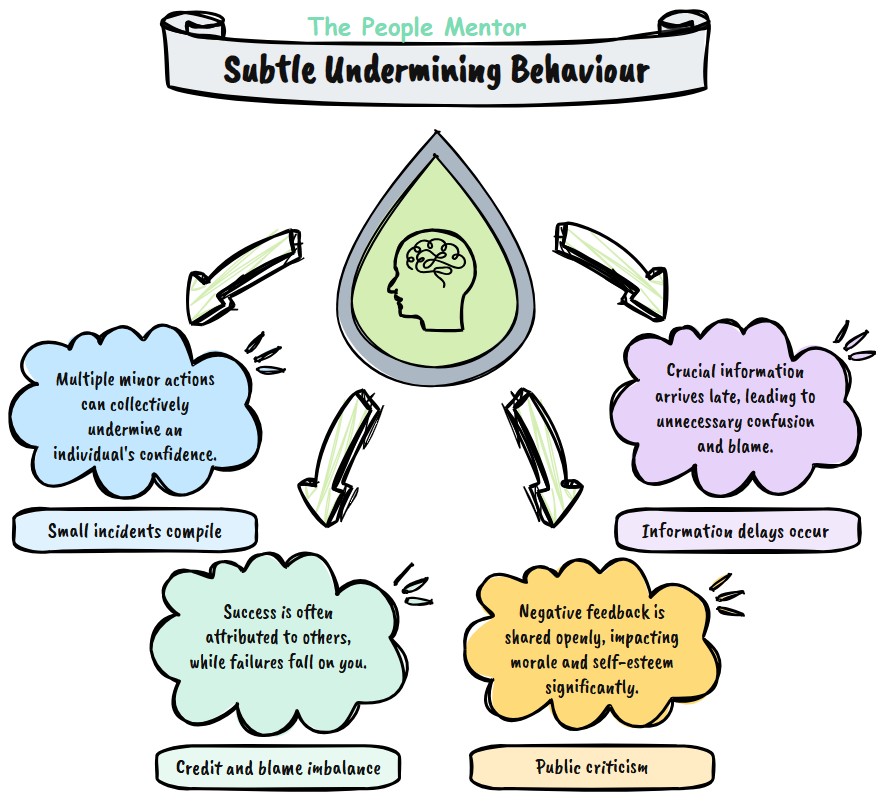
The behaviour is rarely dramatic. If it were, somebody would have dealt with it already. What you are looking at is a run of small things, and you can explain each one away. Put them together, and they make a capable person doubt themselves.
- The information they need turns up late or not at all, and then they get asked why they didn’t know.
- Credit goes up, and blame comes down, every time rather than now and again
- Criticism happens in front of other people, while any support happens privately where nobody can see it
- Their work gets picked over at a level nobody else’s does, or they are left completely alone with no way of knowing which version they will get this week
- Ideas are dismissed in the meeting and adopted later by somebody else
- Sarcasm, backhanded compliments and silence used as a reply rather than a pause
Not one of those would survive a formal process on its own. And this is the point. The frequency is the evidence, so the question is not whether any single item was serious enough, but whether this keeps happening to the same person in the same direction. What to do when a co-worker undermines someone goes into the individual behaviours in more detail.
Why your own record has to carry the weight
Bullying has no standalone legal definition in UK employment law. ACAS describes it broadly as unwanted behaviour from a person or group that is offensive, intimidating, malicious or insulting, or an abuse of power. Harassment sits differently, because it is unlawful under the Equality Act 2010 where the behaviour relates to a protected characteristic. So for much of what lands on your desk, no neat legal test is waiting to sort it out for you.
Meanwhile, a pattern you have left alone can still cost you, because every contract of employment carries an implied duty of trust and confidence. In plain terms, you are expected not to wreck the working relationship with your own employee.
None of this is legal advice. I am a mentor, not a lawyer or an HR adviser, so check the current ACAS guidance and take proper advice on anything that looks like it is heading towards a formal process. The practical consequence is the same either way: a clear factual record turns a feeling into something you can act on. Documenting it is the first step. My piece on the three steps to banishing bullying covers what to do once you can see the pattern.
How to document workplace bullying so the record is actually usable
Plenty of managers keep notes. Far fewer keep notes that help them, because most of us write down how a conversation felt rather than what happened. One is a story. The other is a fact.
The six things every entry needs
This applies whether you saw it yourself or somebody brought it to you.
- When it happened, and when you wrote it up. Those are two different dates, and you want both.
- Where it happened, and how you know. Were you in the room, or is this what you have been told?
- Who else was there? Names, and a note if nobody else was there at all
- What was said or done, in plain words. As close to the actual wording as you can manage
- The effect on the work. What got delayed, redone, avoided or escalated as a result
- What you did next. What you said at the time, what you committed to, and by when
What a usable entry looks like
Here is the entry most managers write: 14/10, spoke to Priya, ongoing issues with her manager, will monitor.
Eighteen months later, that tells you nothing. You can’t see what happened, who else saw it, or what you promised her.
Here is the same conversation written properly:
Tuesday 14th October. Priya came to me at 10.15, straight after the weekly team meeting, and I wrote this up the same afternoon. I was not in that meeting, so this is what she told me. In front of five colleagues, including Jo and Sam, her manager asked whether she had actually read her own report before sending it, and when she offered to take him through it, he said he would rather not waste the meeting on it. She says this is the fourth time since September he has questioned her work in front of the team, and that he has raised nothing with her one-to-one. She is now asking a colleague to check her reports before they go out, which added two days to the last one. I told her I would speak to Jo, review the meeting notes, and get back to her by Friday.
Notice what that second version does. It separates what she saw from what you saw, so nobody can accuse you of writing up hearsay as fact. And it names the people who were in the room. It puts a cost on the work. And it records what you committed to and by when, which means you can be held to it.
Notice something else, too. Even that entry doesn’t prove bullying on its own, and it isn’t trying to. Nothing you write down on a Tuesday ever will. What it does is stand up when you put it next to the other eleven, and that is what gives you a file you can act on.
What to leave out when writing out bullying Incidents
- Interpretation. Bullying, deliberate, malicious and toxic are conclusions, and conclusions are the first thing anybody will contest
- Diagnosis of any kind, whether of the person whose behaviour it is or of the person who has brought it to you. Nobody writing an internal note is qualified to apply a clinical label, and one sitting in a file will follow you into any formal process that follows.
- Stacked adjectives, since they make a factual record read like an argument
- Character rather than behaviour. He is arrogant is an opinion, while he interrupted three times in twenty minutes is a fact
- Second-hand accounts written up as though you saw them. This one matters most on your side of the desk, because most of what you record will be second-hand. Mark clearly what you were told and who told you
Four practical things make the difference between a record and a pile of notes.
Write it the same day, because accuracy fades faster than any of us expect. Write every entry as though the person it is about will read it, because they may well be entitled to, and that single instruction will clean up your managers’ note-keeping faster than any training I could give them.
Keep it where the organisation can actually retrieve it, because a note in one manager’s inbox leaves when they do, and these situations outlast the person who first noticed them. And take advice before anybody secretly records anybody, because it may breach your own policy and it will certainly change how the whole thing looks afterwards, whatever it picks up.
So set that out as the standard for every manager you have. When, where and how you know, who was there, what was said, the effect on the work, and what you did next. The record only works if it’s the same shape wherever it’s written.
How to work out what you are actually looking at
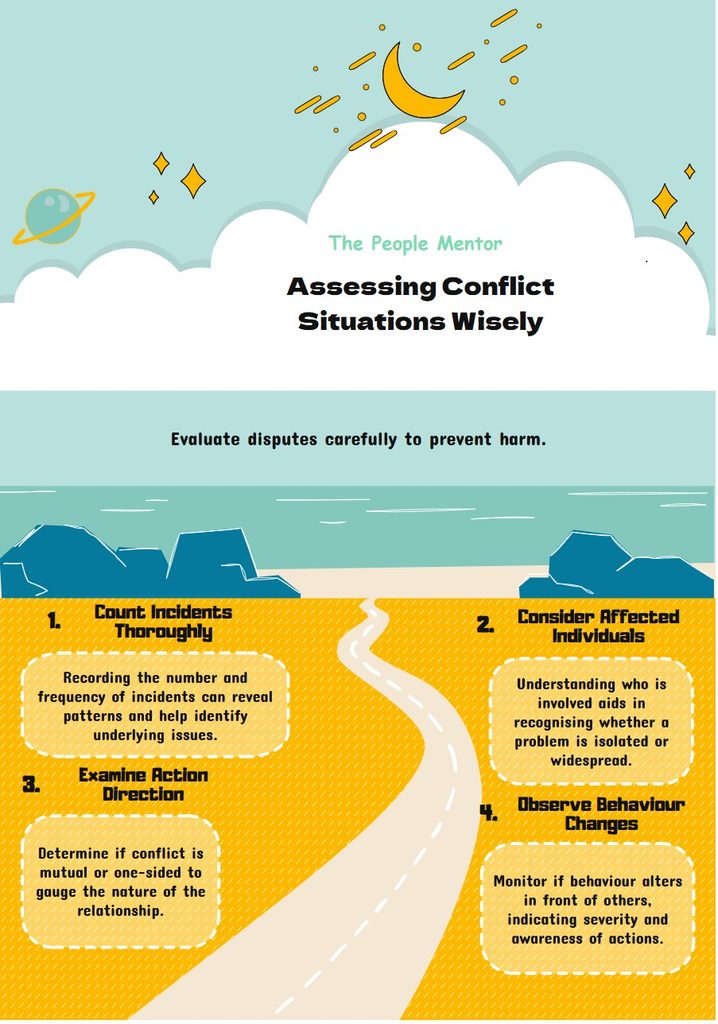
Be careful here. If you make your mind up too early you can do real damage to either of them, so check three things first.
First, frequency and spread. Count the incidents and check who they happen to, because a run of twelve over four months involving the same person tells you something that four incidents across twelve people do not.
Second, direction. Does this only go one way? Two people who don’t get on will rub each other up the wrong way in both directions. This tends to go one way nearly every time.
Third, the audience test. Does the behaviour change when somebody else walks in? If it softens the moment a senior colleague is in the room, he is choosing when to do it, and that is not a blind spot.
Then run the counter-test, because sometimes the honest answer is something else entirely. I was once asked to troubleshoot a struggling team, and it quickly became clear the manager was not really managing. She was understandably defensive when I raised it, and I had already decided what that meant.
As we drilled down, though, we found that things at home were taking most of her attention. The issue still needed addressing, and I still addressed it, but I handled it completely differently than I would have without that context.
I have seen the same thing with resistance. On a fast-moving IT project, one stakeholder challenged almost every decision and slowed everything down, until a direct conversation revealed how much she was carrying. Once that was in the open, the dynamic changed within a fortnight.
At The People Mentor, I look for the pattern beneath the behaviour before assuming somebody is simply being difficult.
The same caution works in the other direction, and this one catches employers out. A manager who is finally tackling poor performance properly is doing exactly the right thing, and that is a real strength. But it will involve repeated, uncomfortable conversations with the same person week after week. To the person on the receiving end, that can feel like being singled out, and they may well describe it to you using the same words as everything above.
So ask that manager to show you three things: the standard they are measuring against, the examples behind it, and the support they have offered. If all three are there, you are looking at poor performance being managed rather than a pattern of the kind described here. If any of them is missing, you have not got performance management yet. You have got a manager who needs help with it, or something else going on entirely, and you need to find out which.
| What you may notice | What it could mean | What to do next |
|---|---|---|
| The same person is on the receiving end of a run of small, deniable incidents | A pattern rather than one-off friction | Start a dated record using the six points and judge it on frequency, not severity |
| The behaviour softens the moment a senior colleague walks in | It is a choice, not a blind spot | Write down who was present each time, because that is your clearest evidence |
| The friction runs in both directions between two people | Two people who do not get on rather than a pattern | Deal with it as a working relationship problem, with both of them in the room |
| One manager is having repeated hard conversations with the same person | Poor performance being managed, which is the right thing | Ask for the standard, the examples and the support before you decide anything |
| A capable person has gone quiet, stopped offering ideas and started escalating decisions | They have adapted around something nobody has reported | Ask them directly, and write down what they tell you the same day |
| A manager gets defensive when you raise how they are managing their team | Could be guilt, could be something going on you know nothing about | Ask before you conclude, because defensiveness on its own is not evidence |
What to say when it finally reaches you
Three replies close the conversation down, and all of them are well-meant. “Have you tried talking to them?” It throws the problem straight back to the person with the least power to fix it.
“Are you sure you are not reading too much into it?” Tells them they were right to doubt themselves, which is exactly what they have been fighting.
“And he is like that with everyone” becomes a pattern of who he is, and you have now agreed to it.
Ask instead for the detail, in a way that makes it clear you are gathering facts rather than testing their credibility.
- “Can you take me through the last three times this happened, with dates if you have them?”
- “Who else was in the room on those occasions?”
- “What has changed in how you work since this started?”
- “What would a good outcome look like for you?“
Then be straight about what happens next. Tell them what you will do, what you cannot do, and by when they will hear from you. And do not promise confidentiality you may not be able to keep. Vague reassurance now turns a manageable situation into a formal complaint later, and addressing employee complaints about management gets much harder once trust in the process is gone.
What to say to the person the bullying concern is about
This is where vague feedback does real damage. If you tell someone there are concerns about their style, a dominant personality will hear a clash of personalities and carry on as before. Give them three dated examples and the business consequence of each, and they have something they cannot dismiss.
Years ago, after an equal opportunities meeting, I raised concerns about bullying I had become aware of. What made the difference was not the actual raising it. It was doing four things in order. I put together a practical awareness approach so the standard was clear to everyone, rather than aimed at one person. And then I spoke directly to the person involved instead of letting the message travel through others. I made sure the manager and I were aligned on what had to change. We agreed on what would change, then monitored it, rather than assuming one conversation had done the job.
The behaviour changed. Most organisations skip that last step, and it decides whether anything actually moves. Avoiding the conversation altogether has its own cost, as shown in why avoiding difficult conversations is so damaging to your team.
Stop relying on one person’s memory.
Everything above gets easier if your organisation already keeps records out of habit rather than self-defence.
A handful of practical changes do most of the work.
- Make written summaries normal. Ask every manager to write a short summary after any significant conversation, every time. If everybody does it, it never looks like somebody building a case.
- Be clear about how performance is judged. When the standard is vague, the loudest person’s opinion counts as evidence.
- Give people more than one way to raise a concern. One route through the line manager is no route at all when the line manager is the problem.
- Say what managers must write down and keep. If you have never told them, you cannot be surprised by what is missing.
- Be willing to change a reporting line. Asking whether it has to stay as it is will often be the only thing that genuinely changes the situation.
Creating a safe place for team members to share covers the groundwork that makes this possible.
Final thought
Most of these situations carry on because somebody senior has quietly decided that one person is worth the damage. That is a decision, even when nobody says it out loud, and your team can usually tell it has been made.
A record takes that decision out of the dark. Twelve dated entries going the same way make it very hard for anyone to carry on choosing not to see it, and that includes you.
If you want to know where your own organisation is exposed on this, take the Management Exposure Check. It is a short self-assessment for employers, it takes a few minutes, and it gives you a report showing where your management practice is solid and where it is leaving you carrying risk you had not considered. Start there, then decide what needs your attention first.