I want to start with something that might feel a little uncomfortable.
You might have read my previous blog, The Untapped Talent Hiding in Plain Sight, and come away thinking, “Right, I understand neurodiversity better now. I know about masking. I know I need to be more curious about the person in front of me.” And that is genuinely a brilliant starting point.
But here is what I have seen happen next, time and time again.
A manager learns more about neurodiversity, genuinely wants to do better, and then the culture around them doesn’t shift. The systems stay the same. The unwritten rules stay the same. The way meetings run, the way feedback is given, the way performance is measured, all of it stays the same. And one well-meaning manager, however motivated, cannot single-handedly override a culture that was never designed with neurodiverse people in mind.
So this blog is about something bigger. It’s about culture. And what you, as a leader or manager, can actually do to change it.
Culture is the water your team swims in
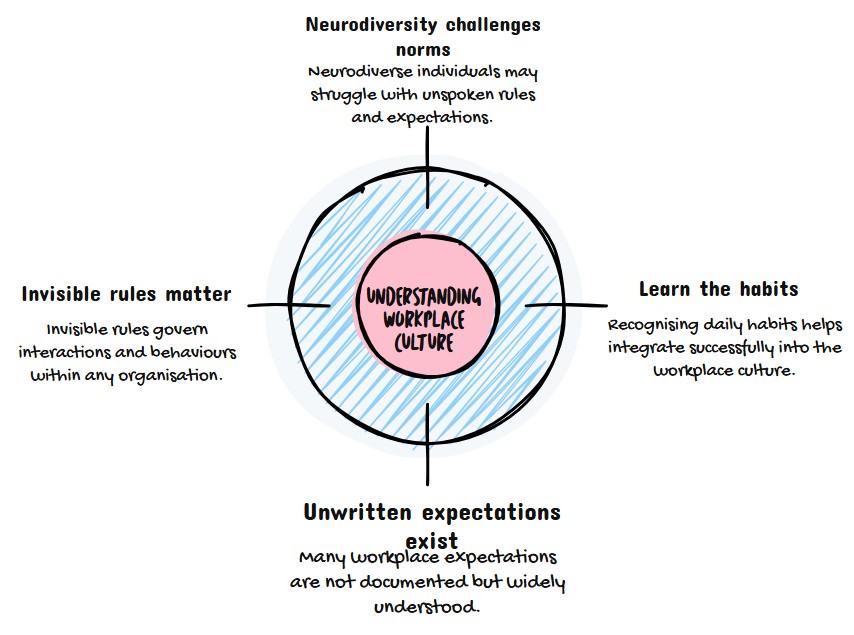
Culture is one of those words that gets used a lot and defined rarely. But when I think about it in practical terms, culture is simply how things are done around here. It’s the invisible rules. The habits. The things that nobody ever wrote down but everybody somehow knows.
For neurodiverse employees, those invisible rules can create enormous, exhausting barriers. Think about how many workplaces have an unwritten expectation that you’ll contribute verbally in meetings. Or that you’ll make small talk in the kitchen. Or that you’ll pick up on subtle social cues about when your manager is in a good mood versus when it’s safer to stay quiet.
These are things that many neurotypical people navigate without even noticing, and things that can take significant cognitive energy for someone who is neurodivergent.
The difficulty with culture is that it lives below the surface. You cannot always see it, but you can absolutely feel it. And your neurodiverse team members are feeling it every single day.
What does a neuro-inclusive culture look like?
I want to be specific here, because vague good intentions are not enough. A neuro-inclusive culture is not one in which everyone pretends neurodiversity doesn’t exist. It is one where difference is expected, respected, and genuinely accounted for in the way the organisation operates.
It starts with what researchers describe as micro-behaviours. These are the small, often barely noticeable things that happen in everyday interactions. Glancing at your phone when someone is speaking. Cutting across someone mid-sentence. Forgetting to brief someone about a change in plan until the last moment.
Individually, these moments can seem trivial. Cumulatively, they tell a person whether they are truly valued and safe in your team, or whether they need to keep their guard up.
A neuro-inclusive culture pays attention to those micro-behaviours. It asks: are our everyday habits actually creating a sense of belonging for everyone, or just for people who happen to fit the majority mould?
This builds on something I talk about in the context of difficult conversations all the time: psychological safety. If your team members don’t feel truly safe being themselves, asking for what they need, or flagging when something isn’t working, you will not know until the damage is already done.
Whether the topic is a performance concern or an individual’s need for a slightly different way of working, psychological safety is the non-negotiable foundation. You can read more about how psychological safety connects to the culture and conversations we avoid.
The cultural elements that matter most
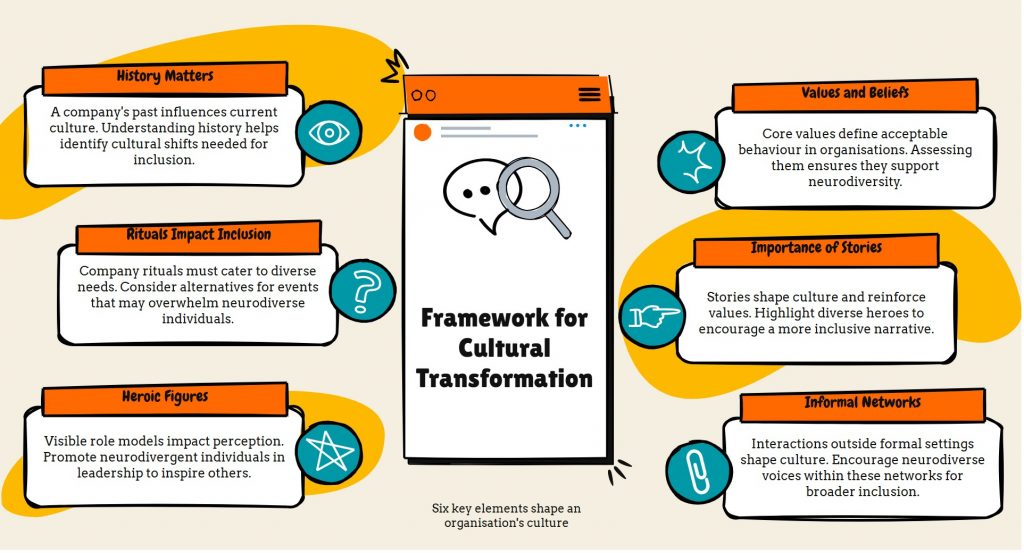
There is a helpful framework I often think about when working with leaders on culture change. It identifies six core elements that shape any organisation’s culture: history, values and beliefs, rituals and ceremonies, stories, heroic figures, and the informal network.
All six of these have a direct bearing on whether neurodiverse people feel they belong in your organisation.
Take stories, for instance. The stories an organisation tells about itself – who gets celebrated, whose successes are shared, whose career trajectory is held up as the example to follow and sends powerful signals about who fits.
If every success story in your team involves the person who is brilliant at presenting, always first to speak up in meetings, and effortlessly confident in social situations, what does that say to someone whose strengths show up differently?
Or think about rituals and ceremonies. Does your team’s culture rely heavily on after-work socials, loud group events, or networking-style gatherings? Are those the spaces where relationships get built and opportunities get discussed?
If so, you may be inadvertently locking out people who find those environments genuinely overwhelming – not because they don’t want to connect, but because the format doesn’t work for their brain.
And what about your heroic figures? Who are the role models in your team or organisation? Are any of them openly neurodivergent?
Because representation matters enormously for belonging. When someone can look around and see that a person who thinks like them has succeeded and thrived, it changes what feels possible.
How to start shifting the culture for Neuro-Inclusion
The good news is that culture change does not have to be a grand, top-down initiative. In my experience, it often starts with one manager who is willing to do things differently and be consistent about it. Here is where I’d suggest starting.
First, look at your meetings. Meetings are among the biggest cultural flashpoints for neurodivergent people. The expectation to process information in real time, respond quickly, hold eye contact and manage the social dynamics of a group simultaneously is genuinely demanding.
- Try sharing agendas in advance.
- Try creating ways for people to contribute, both in writing and verbally.
- Try building in a moment of thinking time before inviting responses. None of these changes requires a policy document. They require a decision.
Second, get curious about your team’s needs before assuming you already know them.
One of the most powerful things a manager can do is simply ask: “What does a good working environment look like for you?” or “Is there anything about the way we do things that makes your job harder than it needs to be?”
You will need to have built enough trust for people to answer honestly, and if you haven’t yet, that is the more important conversation to focus on first. I wrote about the trust-first principle in: How to Build Trust and Credibility with Your Team for High-Performing, and it applies here just as much as it does to any difficult conversation.
Third, challenge the invisible rules. Ask yourself: which of the things we just do in our team are necessary, and which of them simply replicate how things have always been done?
The expectation that everyone should want to make small talk. The assumption that a quiet person in a meeting is disengaged. The unspoken requirement to be on and visible in a particular way. Some of these norms exist for good reason. Others exist purely out of habit. The ones that exist out of habit are worth questioning.
The manager as culture-setter
Here is the part that I want to be really honest about. You, as a manager, are the single most powerful shaper of the culture your team experiences day to day. Not HR. Not the senior leadership team. You.
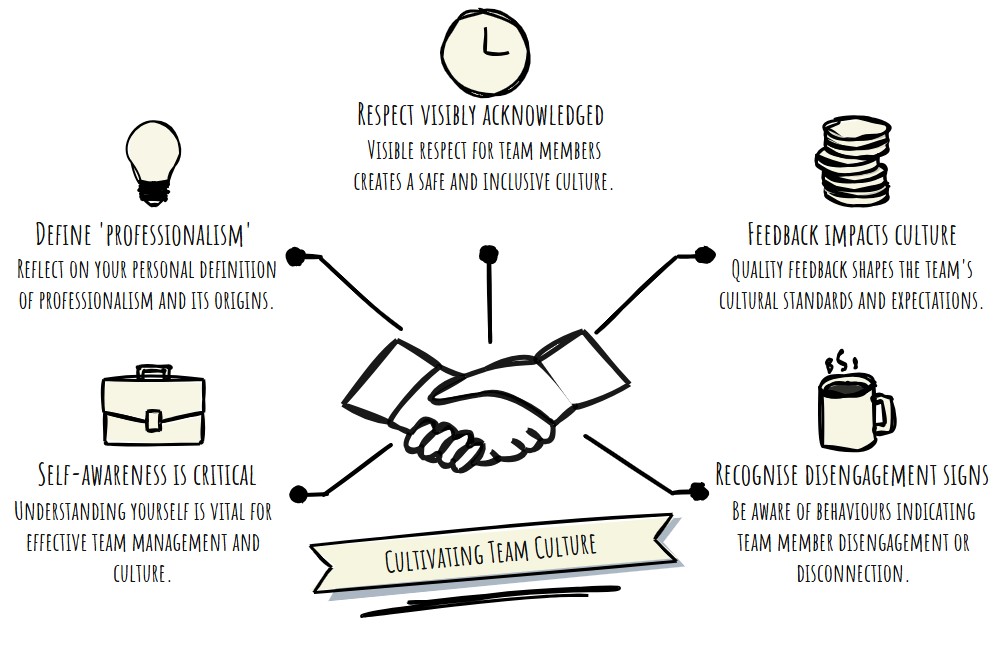
The way you run your meetings, the way you give feedback, the stories you tell, the people you visibly respect and celebrate – all of it creates a signal about what is valued and what is safe.
That is both a significant responsibility and, genuinely, a significant opportunity.
Cultural sensitivity: The kind that actually creates inclusion rather than just avoiding offence is built on self-awareness. It requires you to look honestly at your own assumptions and biases.
- What do you automatically interpret as a lack of engagement?
- What behaviours, in your gut, read as professional or unprofessional?
- Where have those assumptions come from, and are they serving your whole team?
I am not suggesting you need to have all the answers. Nobody does. What I am suggesting is that the quality of your self-reflection directly determines the quality of the culture you create. And the good news is that self-awareness is a skill that can be developed, not a personality trait you either have or you don’t.
The conversations that change culture
I want to end here, because this is where my work as a Difficult Conversations Mentor and the topic of neuro-inclusive culture genuinely meet.
Culture does not change through policy documents or awareness training alone.
It changes through conversations. The conversation where a manager genuinely checks in to see whether someone is getting what they need.
The conversation where a team member feels safe enough to say, “Actually, the way we do this doesn’t work for me. Could we try something different?”
The conversation where you address a team dynamic that is creating tension, rather than letting it simmer and calcify into something much harder to shift.
Every one of those conversations requires skill, courage, and a clear framework for what you’re trying to achieve. That is exactly what the COMPASS Conversation Model is designed to support, whether the topic is performance, conflict, behaviour, or creating a more genuinely inclusive way of working.
If you are managing a team and you want that team to genuinely include and retain neurodiverse people, the most important thing you can do is not wait for a culture change programme to start from the top. Start with the conversations you are having and the ones you have been avoiding.
Because culture is built, one interaction at a time. And you have more influence over it than you might think.
If this resonates with you and you’d like to explore how to handle the conversations that shift culture in your team, you are very welcome to get in touch at thepeoplementor.co.uk or book a discovery call. I’d love to help you move from knowing what needs to change to actually knowing how to do it.
Read more on How to Have a Successful Productive Conversation with a Neurodiverse Employee